- Part 1: Singapore Meta Ads Cost Benchmarks (2026)
- Part 2: Three Structural Shifts That Changed Everything in 2026
- Part 3: Fixing Tracking Before Touching Campaigns
- Part 4: Campaign Structure for the 2026 Algorithm
- Part 5: Bidding Strategy — The Correct Progression
- The Tracking Problem Is Bigger Than Most Singapore Advertisers Realise
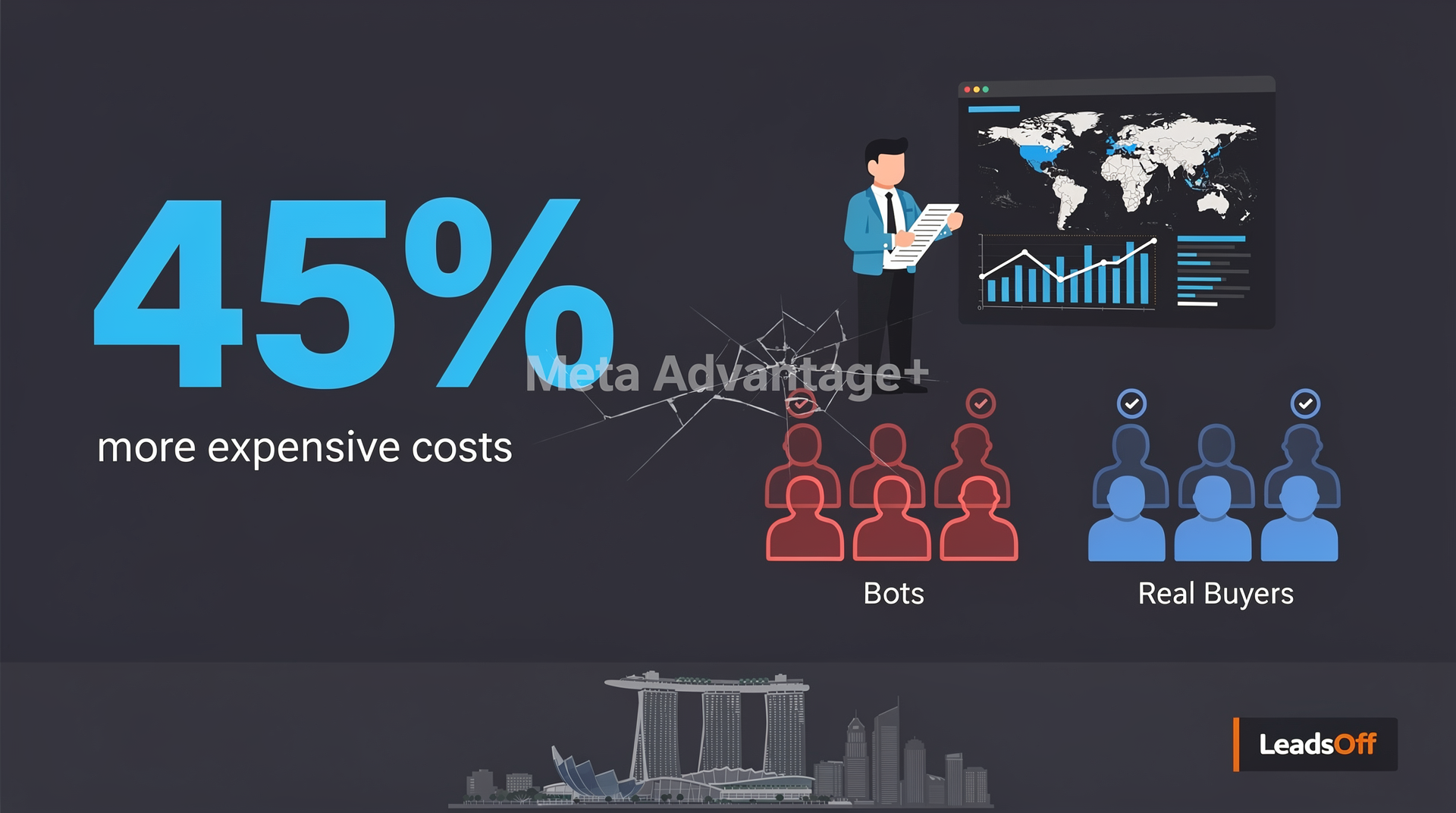
Singapore Meta advertisers are paying roughly 45% more per click than the global average — and most are not getting 45% better results. CPMs peaked at S$40.64 in October 2025, interest-based targeting has been largely gutted, and accounts still running pixel-only tracking are flying blind on 40–60% of their actual conversions.
How Much Are Dead Leads Costing You?
Every lead that doesn't pick up costs you real money. Here's exactly how much.
5 leads ghosted. S$1,000 burnt.
Your dashboard says S$200 per lead. You are actually paying S$300. The difference is fake leads reaching Google before anyone catches them.
Start Free TrialNumbers are estimates based on your inputs. Your actual results depend on campaign setup and lead volume.
This guide covers what the numbers actually look like in 2026, how to structure campaigns for the current algorithm, and — critically — why bad tracking is the silent killer of Singapore ad budgets.
Part 1: Singapore Meta Ads Cost Benchmarks (2026)
Platform-Wide CPM, CPC & CPL Numbers
Singapore's small but affluent market means intense competition for a limited pool of users. Every advertiser is fishing in the same pond.
| Metric | Facebook SG | Instagram SG | Global Average |
|---|---|---|---|
| Avg CPC (all campaigns) | S$0.55 – S$1.80 | S$1.10 – S$2.20 | ~S$1.11 |
| Avg CPM | S$6 – S$14 | S$8 – S$22 | ~S$19.81 |
| Avg CTR (feed) | 0.8% – 1.8% | 1.0% – 2.0% | ~1.11% |
| Avg CPL (lead gen) | S$15 – S$80 | S$18 – S$100 | ~S$40 |
| Conversion campaign CPC | S$1.00 – S$3.00 | S$1.50 – S$3.50 | — |
| Brand awareness CPC | S$0.30 – S$0.80 | S$0.40 – S$1.00 | — |
These are not targets — they are baselines. Accounts with clean conversion data and strong creative consistently beat these numbers. Accounts without both consistently miss them.
Singapore CPM Seasonality — Where Most Budgets Get Burned
Singapore CPMs are nearly 6x more volatile than the global benchmark. The pattern repeats every year:
- Q1 (Jan–Mar): Lowest CPMs of the year — Q4 ad budgets exhausted, reduced competition
- Q2 (Apr–Jun): Costs accelerate as budgets restart; June spikes sharply
- Q3 (Jul–Sep): Elevated but predictable
- Q4 (Oct–Dec): Peak costs — October 2025 hit S$40.64 CPM
The practical rule: Run creative tests in January–March when CPMs are 40–60% lower than Q3–Q4. Scale your proven creatives into Q4 — do not use Q4 budgets to test unknowns.
CPL by Industry — Singapore 2026
| Industry | CPL Range (SGD) | Key Note |
|---|---|---|
| Property & Real Estate | S$40 – S$120 | CEA regulations apply; high transaction values justify elevated CPL |
| Renovation & Interior Design | S$30 – S$100 | Before/after visual content performs strongly |
| Legal Services | S$80 – S$200 | Tiny target audience; high CPC drives CPL up |
| Finance & Insurance | S$60 – S$180 | MAS disclosure requirements restrict ad copy |
| B2B & SaaS | S$50 – S$150 | Meta works for SME owner targeting; LinkedIn often better for enterprise |
| Healthcare & Medical | S$40 – S$120 | MOH regulations restrict claims; visual content is the workaround |
| Education & Training | S$20 – S$60 | Strong for parent and working professional audiences |
| Beauty, Wellness & Fitness | S$15 – S$50 | Visual-first platform advantage; high engagement rates |
| F&B & Restaurants | S$10 – S$30 | Broad audience keeps CPL low; strong local engagement |
| E-commerce & Retail | S$15 – S$50 | Catalog ads and Advantage+ Shopping are the primary drivers |
What Targeting Precision Costs You
Narrowing your audience does not always improve efficiency — often it raises costs without improving lead quality:
- Broad SG targeting (country, age, gender only): CPM S$6–S$10
- High-net-worth demographics (property, finance): CPM S$15–S$25
- Tight B2B targeting (job title, company size): CPM S$20–S$35
- Retargeting warm audiences (website visitors, video viewers): CPM S$18–S$30, but conversion rates of 5–12% often justify the premium
Part 2: Three Structural Shifts That Changed Everything in 2026
1. Interest Targeting Is Largely Dead
Meta removed key detailed targeting options in January 2026. Most interest categories have been absorbed into Advantage+ Audience, which works from behavioural patterns rather than declared interests. Tight interest stacking — once the go-to tactic for Singapore property and finance campaigns — now frequently hurts performance by preventing the algorithm from finding its best audience.
The counterintuitive reality: broad targeting plus strong creative now outperforms narrow interest targeting in most Singapore verticals.
2. Conversions API Is No Longer Optional
Pixel-only setups miss between 40–60% of actual conversions in 2026 due to:
- iOS 14.5+ requiring opt-in for all Apple device tracking
- Ad blockers affecting 25–30% of Singapore desktop users
- Cookie consent banners reducing browser-side data capture
- Safari ITP and Firefox ETP stripping tracking parameters
When Meta only sees a fraction of your real conversions, it optimises toward the wrong audiences — at higher cost.
Accounts using CAPI alongside the Pixel see an average 17.8% lower cost per result compared to pixel-only setups.
3. Creative Is Now the Primary Performance Lever
With audience targeting largely automated, approximately 80% of campaign performance now comes down to creative strategy — not audience settings. The implication: media buyers who spent years building sophisticated audience structures need to redirect that effort into creative production and testing velocity.
Part 3: Fixing Tracking Before Touching Campaigns
No campaign structure or bidding strategy fixes broken measurement. This is the foundation everything else depends on.
Pixel + CAPI — The Required Setup
| Tracking Layer | What It Captures | What It Misses |
|---|---|---|
| Pixel only | Page views, scroll, real-time behaviour | iOS users, ad blocker users, 40–60% of conversions |
| CAPI only | Server-confirmed conversions | Real-time behavioural signals |
| Pixel + CAPI together | Everything | Nothing — deduplication handles overlap |
Setup Options for Singapore Businesses
Meta CAPI Gateway — Meta's own no-code solution. Works alongside your existing Pixel automatically. Best starting point for most Singapore SMEs; no developer required.
Partner integrations — Shopify, WordPress, and most CRMs include native CAPI integrations. Enable them in the platform settings — this takes minutes and immediately improves data quality.
Server-side custom implementation — Maximum control for technical teams. Sends conversion events (form submissions, purchases) directly from your server via Meta's Business SDK. Requires developer work but captures signals no other method can.
When running both Pixel and CAPI simultaneously, set matching event_id values on both to prevent double-counting the same conversion. This is a one-line implementation detail that most setups miss.
Part 4: Campaign Structure for the 2026 Algorithm
The Account Architecture That Works Now
Fragmenting budgets across many ad sets and audiences — the old way — actively prevents Meta's algorithm from accumulating enough signal. The 2026 structure is leaner and counterintuitively broader:
AWARENESS (20–30% of budget)
- Objective: Video Views or Reach
- Audience: Broad — Singapore, age range, gender only. No interests.
- Purpose: Build retargeting pools of video viewers and page engagers
CONSIDERATION (20–30% of budget)
- Objective: Traffic or Engagement
- Audience: Warm audiences — 25%+ video viewers, page fans, Instagram followers
- Purpose: Move warm audiences toward conversion intent
CONVERSION (40–50% of budget)
- Objective: Leads or Purchases
- Audience: Advantage+ Audience (broad) or specific retargeting segments
- Purpose: Generate qualified leads at target CPL
CBO vs ABO — The Honest Guide
| Scenario | Recommended Approach | Reason |
|---|---|---|
| Testing 3–5 new creative variants | ABO | Equal budget per ad set gives fair comparison data |
| Scaling proven winners | CBO | Algorithm allocates toward cheapest conversion automatically |
| Daily budget under S$30 | ABO | CBO distributes unevenly at very low spend levels |
| Multiple audiences, strong conversion history | CBO | 80/20 allocation surfaces best audience without manual management |
| Local B2B, coaching, niche services | ABO | Frequency control and spend distribution matter more here |
The hybrid approach used by experienced Singapore media buyers: Run ABO for testing with equal budgets across creative variants. After 48–72 hours, identify winners. Move the winning post ID into a CBO scaling campaign. Let CBO handle budget distribution across proven creatives.
Advantage+ vs Manual Campaigns
| Dimension | Advantage+ | Manual |
|---|---|---|
| Audience decisions | AI-driven, broad | Custom audiences, lookalikes |
| Learning phase exit | ~30% faster | Standard pace |
| Cost per purchase | ~12% lower on average | Baseline |
| Conversion data requirement | 50+ weekly conversions recommended | Works with lower volume |
| Best for | E-commerce, scaled lead gen | New accounts, tight B2B niches, explicit exclusions needed |
Advantage+ wins when you have enough conversion data and strong creative assets. Manual wins for new accounts, niche B2B audiences in Singapore, and any campaign requiring explicit audience exclusions that Advantage+ cannot enforce.
Part 5: Bidding Strategy — The Correct Progression
Meta's four bidding strategies are not interchangeable. Using the wrong one at the wrong stage is one of the most common ways Singapore advertisers waste budget in weeks one and two.
| Strategy | Best For | The Risk |
|---|---|---|
| Highest Volume | New campaigns, data gathering | CPL varies widely; no cost floor |
| Cost Per Result Goal | Scaled lead gen with known CPL target | Restricts delivery if target is too aggressive |
| Bid Cap | Competitive niches requiring strict cost control | May severely limit delivery and miss auctions |
| ROAS Goal | E-commerce with 50+ weekly purchases | Requires strong conversion data to function reliably |
The Progression That Prevents Wasted Spend
Weeks 1–3: Run on Highest Volume with no target. Record your actual CPL — this is your real baseline, not a benchmark table.
Week 4 onwards: Add a Cost Per Result Goal set 15–20% above your recorded CPL. Tighten it gradually over two to three weeks.
Month 2+ (e-commerce only): Test a ROAS Goal set 10–15% below your current ROAS. This requires at least 50 purchases per week to produce reliable optimisation — below that threshold, the algorithm is guessing.
Budget scaling rule: Never increase a campaign budget by more than 20% at a time. Wait at least 48–72 hours between increases. Scaling faster than this resets the learning phase and causes CPL to spike — a pattern LeadsOff sees repeatedly when auditing Singapore Google Ads and Meta accounts that have been scaled aggressively.
The Tracking Problem Is Bigger Than Most Singapore Advertisers Realise
Whether you are running Meta ads or Google Ads in Singapore, the single most common issue LeadsOff encounters in account audits is the same: conversion data that looks complete but is not. Pixel-only Meta tracking and Google Ads without offline conversion imports both suffer from the same structural problem — the platform optimises toward the signals it can see, which is an increasingly small fraction of reality.
For Singapore property advertisers specifically, this creates a second-order problem. When tracking misses 40–60% of real conversions, Meta and Google's algorithms fill that gap by optimising toward whatever signals are measurable — including spam form submissions, low-intent clicks, and fake leads that pass browser-side tracking checks but never had any purchase intent.
Clean conversion data is not a nice-to-have. It is the difference between an algorithm that finds genuine buyers and one that finds cheap clicks from people who will never transact.
LeadsOff's spam filtering layer works at the point where this matters most: verifying that the conversion signals being sent back to Meta and Google reflect real, qualified intent — not form spam, bot submissions, or duplicate entries that inflate your conversion count and corrupt your optimisation data.
Fix your tracking. Clean your conversion signals. Then run the campaign structures above. In that order.

The LeadsOff team builds spam-blocking infrastructure for Google Ads lead forms across Singapore. Our articles are drawn from live campaign data, client blocklist patterns, and direct analysis of how fake leads corrupt Smart Bidding. We publish when we have something real to say.
LeadsOff catches the fake leads Google can't. Setup in 30 minutes.
Get Started →