- Singapore Advertisers Are Running Two Campaigns Simultaneously — And Only Paying Attention to One
- The Real Cost of a Spam Lead Goes Far Beyond the Click
- How Spam Leads Silently Destroy Google Smart Bidding
- Singapore Industry Breakdown: Who Is Losing the Most
- The Property and Renovation Case: Singapore's Highest-Stakes Segment
- Platform-by-Platform: Where Spam Enters and What It Costs
- The CRM Pollution Problem Most Singapore SMEs Ignore
- What LeadsOff Actually Does at the Form Layer
- The Practical Next Step for Singapore Advertisers
Singapore Advertisers Are Running Two Campaigns Simultaneously — And Only Paying Attention to One
Every Google Ads account in Singapore generating leads is running two parallel campaigns whether the advertiser knows it or not. One campaign reaches real buyers — people actively searching for renovation quotes, property viewings, insurance plans, or legal advice. The other campaign subsidises bots, click farms, and zero-intent form fillers who will never pick up the phone.
How Much Are Dead Leads Costing You?
Every lead that doesn't pick up costs you real money. Here's exactly how much.
5 leads ghosted. S$1,000 burnt.
Your dashboard says S$200 per lead. You are actually paying S$300. The difference is fake leads reaching Google before anyone catches them.
Start Free TrialNumbers are estimates based on your inputs. Your actual results depend on campaign setup and lead volume.
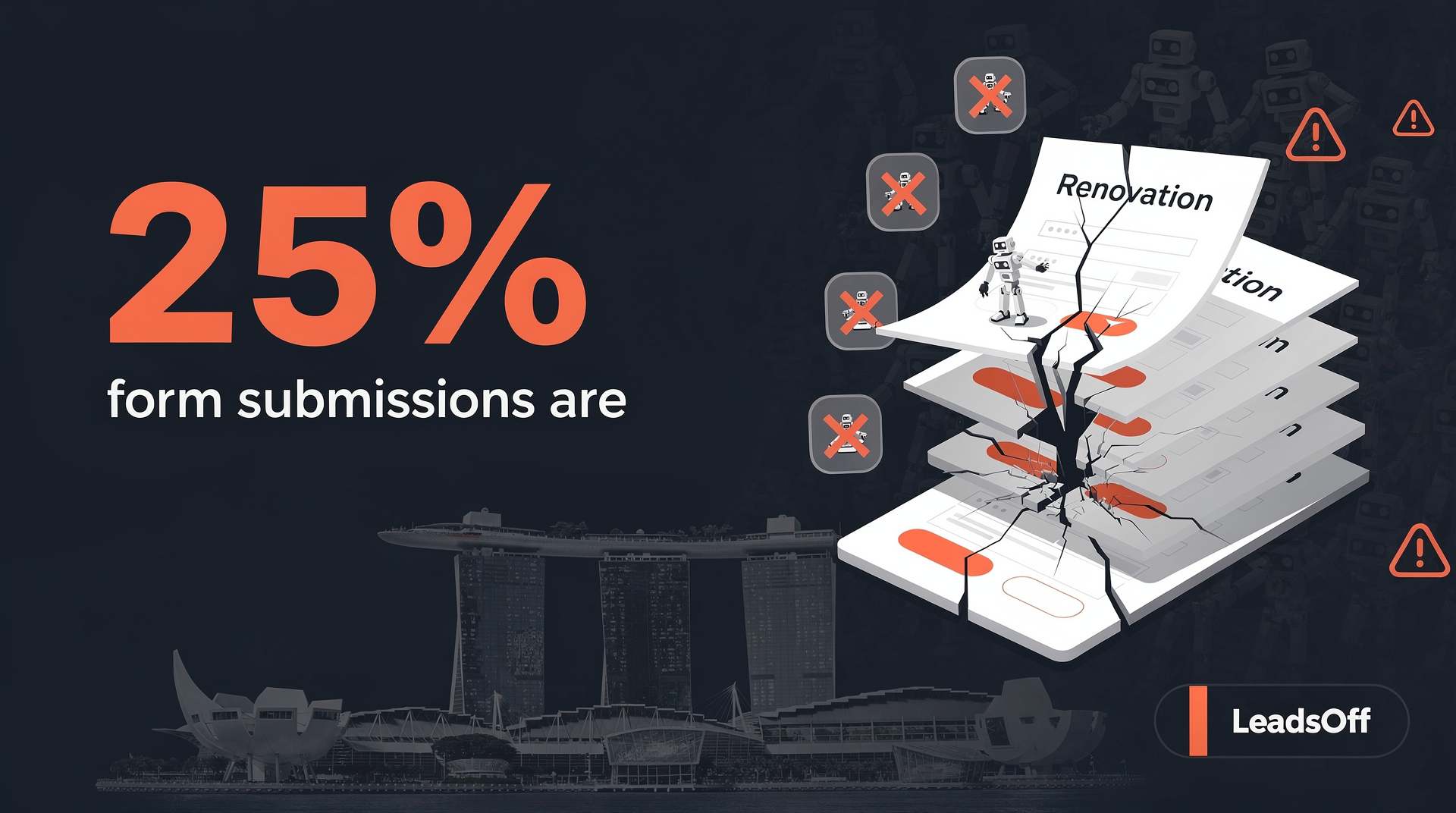
The split is not marginal. Industry data puts non-human web traffic at 38–42% of all web traffic globally. On paid ad forms specifically, roughly [25% of all form submissions are invalid](https://leadsoff.com/blog/lead-quality--spam-rates-by-ad-platform-2026-singapore) — fabricated by bots, click farms, or fraud rings before you even account for low-intent human submissions that clog up your CRM.
For a Singapore advertiser spending S$5,000–S$15,000/month on Google Ads or Meta, that translates to S$1,250–S$3,750 in direct monthly spend generating zero pipeline. Every single month.
This article breaks down exactly where that money disappears, which Singapore industries are hit hardest, and why cleaning up your conversion signals is the highest-ROI action you can take right now.
The Real Cost of a Spam Lead Goes Far Beyond the Click
Most advertisers think about spam leads as wasted ad spend — you paid for a click, a bot filled in your form, money gone. That is actually the cheapest part of the problem.
Each fake lead that enters your CRM triggers a chain of downstream costs:
| Cost Category | Per Spam Lead | Annual Impact (100 leads/month) |
|---|---|---|
| Wasted ad spend | S$25–S$120 | S$3,000–S$14,400 |
| Sales rep follow-up time (27% of rep time lost to bad data) | S$15–S$40 | S$1,800–S$4,800 |
| CRM cleaning and deduplication | S$3–S$8 per record | S$360–S$960 |
| Smart Bidding algorithm degradation | Compounding CPL increase | 10–25% CPL inflation over 60 days |
| Attribution corruption and budget misallocation | — | 15–25% revenue impact |
| Total per spam lead | S$43–S$168 | — |
The algorithm degradation row is the one most Singapore advertisers miss entirely — and it is arguably the most expensive item on the list.
How Spam Leads Silently Destroy Google Smart Bidding
Google's Smart Bidding — whether you are running tCPA, tROAS, or Maximise Conversions — works by building a predictive model of who converts. It analyses device type, location, time of day, search behaviour, and hundreds of other signals to decide which users are worth bidding higher for.
When spam form submissions are recorded as conversions in your account, Smart Bidding learns from those fake patterns. It begins identifying the demographic, geographic, and behavioural fingerprints of bot traffic — and then goes looking for more users who match that profile.
The Four-Stage Degradation Cycle
Stage 1 — Spam counted as conversion: A bot submits your contact form. Google Ads records a conversion. Smart Bidding adds that signal to its model.
Stage 2 — Algorithm targets bot-like traffic: The model begins favouring traffic that resembles previous converters — which now includes bot characteristics. CPL appears stable or even improves on paper because conversion volume holds up.
Stage 3 — Real conversion rate quietly drops: Valid leads per click decline. Your sales team notices fewer good enquiries even though the dashboard looks fine.
Stage 4 — Budget misallocation compounds: Performance Max distributes budget across Search, Display, YouTube, Gmail, and Discovery based on those corrupted conversion signals. Budget migrates toward the cheapest, lowest-quality placements that bots favour.
One documented case study found that after implementing fake lead filtering, CPC dropped 85% and ROI increased 152% — with no change to budget or creative. The entire gain came from signal quality improvement alone.
The fix is straightforward: only send verified, real buyer conversions back to Google as conversion events. When LeadsOff blocks spam at the form layer, only genuine enquiries enter the conversion tracking pipeline — and Smart Bidding optimises toward actual buyers.
Singapore Industry Breakdown: Who Is Losing the Most
Spam rates are not uniform across industries. Property, renovation, and healthcare ads attract significantly higher volumes of invalid submissions than B2B SaaS or e-commerce. Here is what the numbers look like for Singapore advertisers running a S$5,000/month budget:
| Industry | Avg CPL (SGD) | Est. Spam Rate | Effective CPL (clean leads only) | Monthly Wasted Spend |
|---|---|---|---|---|
| Property / Real Estate | S$80–S$200 | 30–50% | S$114–S$400 | S$1,500–S$2,500 |
| Renovation / Interior Design | S$60–S$120 | 25–45% | S$80–S$218 | S$1,250–S$2,250 |
| Legal Services | S$150–S$300 | 10–20% | S$167–S$375 | S$500–S$1,000 |
| Finance & Insurance | S$80–S$180 | 15–25% | S$94–S$240 | S$750–S$1,250 |
| Healthcare / Aesthetic | S$60–S$120 | 20–35% | S$75–S$185 | S$1,000–S$1,750 |
| Education / Training | S$40–S$80 | 20–35% | S$50–S$123 | S$1,000–S$1,750 |
| B2B SaaS | S$80–S$200 | 10–20% | S$89–S$250 | S$500–S$1,000 |
| Fitness / Wellness | S$30–S$70 | 15–25% | S$35–S$93 | S$750–S$1,250 |
The effective CPL column is what should concern you most. A renovation company reporting S$80 CPL is not actually paying S$80 per usable lead — they are paying S$80–S$218 once spam is stripped out. Every performance report that does not account for spam rate is measuring the wrong number.
The Property and Renovation Case: Singapore's Highest-Stakes Segment
Property and renovation are the two industries where spam protection has the clearest financial case in Singapore. A single renovation project runs S$30,000–S$150,000. A property transaction commission ranges from S$8,000–S$50,000. Yet both industries consistently report 30–50% spam rates on Meta Instant Forms — the primary lead channel for both sectors.
Worked Example — Renovation Company, S$8,000/Month Meta Budget
| Scenario | Without LeadsOff | With LeadsOff |
|---|---|---|
| Gross leads/month | 100 | 100 |
| Spam / invalid leads | 40 (40%) | 6 (6%) |
| Valid leads to follow up | 60 | 94 |
| Lead-to-sale rate (of valid leads) | 8% | 9% |
| Closed deals/month | 4.8 | 8.5 |
| Avg project value | S$55,000 | S$55,000 |
| Revenue/month | S$264,000 | S$467,500 |
| Incremental revenue | — | +S$203,500/month |
The 9% conversion rate improvement in the LeadsOff column is not an assumption — it reflects the documented advantage when clean conversion signals train the algorithm rather than bot-contaminated data. Valid clicks convert at roughly 2x the rate of invalid clicks in controlled studies.
Platform-by-Platform: Where Spam Enters and What It Costs
The spam problem is not limited to one channel. Every lead generation surface is vulnerable, and each platform responds differently when fake conversion signals enter its machine learning pipeline.
| Platform | Primary Spam Vector | Impact Without Protection |
|---|---|---|
| Google Search Ads | Bot clicks on landing page forms; Search Partners fraud | CPL rises 10–25% as Smart Bidding optimises toward bot-like traffic |
| Google Performance Max | Display and YouTube bot traffic submitting forms | PMax shifts budget toward cheapest invalid placements; real leads decline |
| Meta Instant Forms | Pre-filled forms submitted by bots or accidentally (25–40% junk) | Advantage+ lookalike audiences resemble fraudsters, not buyers; CPM inflates |
| Meta Landing Page Ads | Bot crawlers; low-intent users submitting for freebies (8–15% junk) | Lower junk rate but still corrupts Meta CAPI signal quality |
| TikTok Lead Gen | Native form auto-fill junk (15–30%); Southeast Asia bot farms | Algorithm trains on Gen Z bot profiles; budget misallocated toward low-intent signals |
| Organic / SEO forms | Bot crawlers; spam farm submissions (~4% fake rate) | CRM pollution; false conversion signals in GA4 |
Meta's Advantage+ Problem Specifically
Meta's automated targeting depends entirely on the quality of conversion events fed back from your site. When fake lead submissions fire as "Lead" events:
- The algorithm learns to find users who resemble the bots that submitted
- Lookalike audiences built on fake signals begin targeting fraudsters rather than real buyers
- Meta's Conversions API (CAPI) deprioritises batches of low-quality matching data, reducing the traffic recovery CAPI was supposed to deliver
- CPM inflates as genuine engagement signals are diluted by fraudulent ones
LeadsOff blocks spam at the form layer before the lead event fires. Meta's algorithm only sees verified buyer conversions — which means Advantage+ optimises toward people who actually want what you are selling.
The CRM Pollution Problem Most Singapore SMEs Ignore
Beyond the ad platform algorithms, spam leads cause a separate class of damage inside your CRM and sales pipeline.
Research puts 27% of sales representative time wasted on following up with bad data. For a Singapore SME with two salespeople at S$4,500/month each, that is S$2,430 in salary cost every month spent chasing numbers that ring out, emails that bounce, and contacts who never submitted a genuine enquiry.
CRM pollution compounds over time:
- Email list health degrades — high bounce rates from fake emails damage your sender reputation and deliverability for real prospects
- Retargeting audiences get contaminated — Custom Audiences built from CRM uploads include bot profiles, reducing match quality and wasting retargeting spend
- Sales forecasting becomes unreliable — pipeline conversion rates appear lower than they actually are for real leads, leading managers to over-invest in volume rather than quality
- Attribution models break — if 25% of your reported conversions are fake, every decision about which campaigns, keywords, or creatives to scale is based on corrupted data
What LeadsOff Actually Does at the Form Layer
LeadsOff sits between your ad platform and your CRM, validating every form submission before it is recorded as a conversion or passed to your sales team.
For Google Ads accounts, this means:
- Spam submissions are blocked before the Google Ads conversion tag fires
- Smart Bidding only receives clean, verified buyer signals
- CPL figures in your dashboard reflect actual cost per real enquiry
For Meta campaigns, this means:
- Fake lead events never reach CAPI
- Advantage+ and Lookalike audiences are built from genuine buyer data
- Your sales team receives a filtered list of leads worth calling
For Singapore property and renovation advertisers specifically, LeadsOff flags duplicate submissions, validates phone numbers against Singapore mobile number formats, and identifies patterns consistent with click farm behaviour in the Southeast Asia region.
takeaways
Key Takeaways
- 25% of form submissions across paid ad campaigns are invalid before accounting for low-intent humans
- Singapore advertisers on S$5,000/month budgets lose S$1,250–S$3,750/month to spam in direct wasted spend alone
- Spam leads corrupt Google Smart Bidding and Meta Advantage+ by training algorithms on bot behaviour — this is the most expensive hidden cost
- Property and renovation advertisers face 30–50% spam rates, making the financial case for protection clearest in those sectors
- Valid clicks convert at 2x the rate of invalid clicks when fraud is removed from the signal stream
- LeadsOff filters spam at the form layer so only verified conversions enter your ad platform, CRM, and sales pipeline
:::
The Practical Next Step for Singapore Advertisers
If your Google Ads or Meta campaigns are generating leads at S$60–S$200 CPL and your sales team regularly complains about lead quality, you are almost certainly experiencing spam contamination. The symptoms — declining contact rates, rising CPL, salespeople reporting that numbers do not pick up — are consistent with algorithm degradation from dirty conversion signals.
The starting point is measuring your actual spam rate. LeadsOff provides a lead audit that shows the proportion of invalid submissions your campaigns are currently generating, broken down by source, device type, and submission pattern.
For most Singapore advertisers in property, renovation, healthcare, or finance, the audit result is the same: a spam rate between 20% and 50%, and a true CPL that is 30–100% higher than what the dashboard reports.
Fixing the signal quality costs less than one week of wasted spend. The compounding benefit — cleaner algorithms, better attribution, higher sales team productivity — continues for as long as you run campaigns.

The LeadsOff team builds spam-blocking infrastructure for Google Ads lead forms across Singapore. Our articles are drawn from live campaign data, client blocklist patterns, and direct analysis of how fake leads corrupt Smart Bidding. We publish when we have something real to say.
LeadsOff catches the fake leads Google can't. Setup in 30 minutes.
Get Started →