Your Google Ads campaign is bleeding budget every day — and the fix everyone recommends probably isn't the real problem. Most practitioners point at keywords, bids, or landing pages. Those matter. But the mistake that quietly destroys campaigns runs deeper.
How Much Are Dead Leads Costing You?
Every lead that doesn't pick up costs you real money. Here's exactly how much.
5 leads ghosted. S$1,000 burnt.
Your dashboard says S$200 per lead. You are actually paying S$300. The difference is fake leads reaching Google before anyone catches them.
Start Free TrialNumbers are estimates based on your inputs. Your actual results depend on campaign setup and lead volume.
The setup rarely kills a campaign. What kills it is sending real money into a system that has no feedback loop — no way to know what's working, what's fake, and what's teaching Smart Bidding the wrong lesson.
What Everyone in the Thread Tried First
Practitioners running Google Ads have tried every obvious fix. These aren't wrong instincts — they're reasonable starting points:
- Switching from broad match to exact match to control irrelevant traffic
- Adding negative keywords to stop budget bleeding on off-intent searches
- Rebuilding landing pages to match ad copy more closely
- Setting up conversion tracking after campaigns were already live
- Reducing the number of campaigns to concentrate budget
- Waiting out the learning phase before making more changes
- Auditing search term reports manually for wasteful queries
All of these are legitimate moves. None of them is the biggest mistake.
Why the Standard Fixes Don't Stop the Real Bleeding
Each of these fixes solves a visible problem while leaving the deeper one untouched.
Not setting up conversion tracking from day one
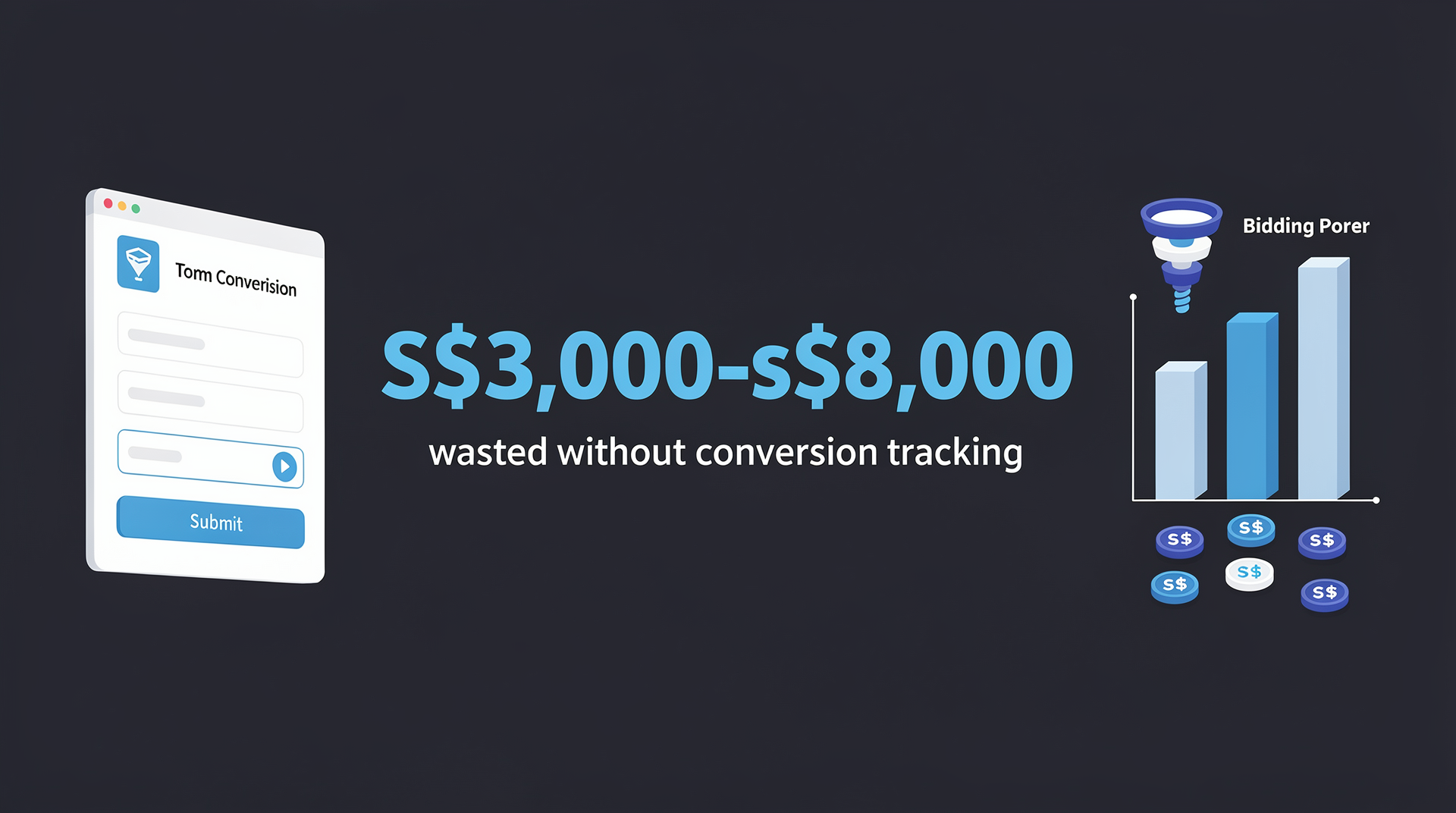
Running ads without conversion tracking is genuinely costly — practitioners report blowing through S$3,000–S$8,000 just watching click counts rise with zero data on what converted. But adding tracking later doesn't undo the damage. Smart Bidding has already been optimising toward nothing for weeks. You're not starting fresh — you're inheriting a poisoned learning history.
Fixing the landing page
Message match matters. If your ad promises a free consultation and your page leads with a product catalogue, people leave. But a better landing page doesn't protect you from the conversions that are recorded incorrectly — form submissions from competitors, lead farms, or low-intent clicks that technically completed your goal. A cleaner page still converts bad leads. Now they're just better-looking bad leads.
Using exact match keywords
Exact match reduces irrelevant traffic. It doesn't filter out intent-matched but low-quality visitors — someone who searches your exact keyword phrase but has no intention of buying still clicks, still lands, still potentially converts. You've spent S$15–S$40 per click in competitive Singapore verticals like property or financial services to reach someone who was never a real prospect.
Adding negative keywords
Negative keyword lists stop known irrelevant searches. They don't stop new variants you haven't seen yet, and they do nothing for the traffic that looks exactly right — correct keyword, correct intent signal — but produces no real business outcome.
Waiting for the learning phase
Patience is right. Changing campaigns every 48 hours does reset the algorithm. But waiting 2–3 weeks while your campaign learns from flawed conversion data isn't patience — it's giving Smart Bidding more time to optimise toward the wrong audience at scale.
| What your campaign reports show | What's actually happening |
|---|---|
| Conversion rate improving week-on-week | Smart Bidding finding more people who fill forms, not more people who buy |
| CPL within target | Low-quality leads accepted as valid conversions, dragging the average down |
| High-intent keywords driving traffic | Competitors, lead farmers, or wrong-fit prospects matching your exact terms |
| Learning phase completed | Algorithm locked onto a conversion profile built from mixed-quality data |
The Gap Nobody in the Thread Solved
Every fix in the discussion targets what happens before the click — keyword selection, match types, bid strategy, ad copy. A few target the landing page experience. None of them addresses what happens between a form submission and a real business outcome.
Irrelevant search term → caught by negative keywords ✓
Bot click → caught by click fraud tool ✓
Real human click, wrong intent → gets through → lands on page
→ reads, scrolls, fills form with real details
→ NOTHING STOPS THIS
→ Google records conversion
→ Smart Bidding learns: find more people like this
→ CPL looks stable, pipeline is empty
The most expensive mistake in Google Ads isn't the one that wastes clicks. It's the one that wastes conversions — because Smart Bidding treats every recorded conversion as a signal. Feed it bad signals long enough and the campaign optimises perfectly toward the wrong outcome.
By the time CPL starts rising noticeably, the algorithm has already spent three to four weeks building a targeting profile around fake or low-quality converters. You're not fixing a problem at that point. You're unwinding one.
What Actually Closes the Gap
The fix isn't upstream — it's at the conversion layer. LeadsOff filters conversion signals before they reach Smart Bidding, removing spam submissions, competitor form fills, and lead farm entries from the data Google uses to optimise. The campaign keeps learning — but from real prospects only.
Cleaning up your keyword list is table stakes. What determines whether your campaign improves or degrades over time is the quality of the conversions you're feeding back into the system.
Signs This Is Already Happening to Your Campaign
- Your CPL looks acceptable but your pipeline is empty — Conversion volume is healthy on the dashboard, but your sales team reports that callbacks go unanswered, emails bounce, or leads have no recollection of enquiring. The gap between reported conversions and real sales conversations is your signal.
- Campaign performance improved during the learning phase, then plateaued or declined — Smart Bidding converged on a targeting profile early. If performance peaked at week three and has drifted since, the algorithm likely locked onto a mix of real and fake converters and is now efficiently finding more of the same.
- Your best-performing keywords in Singapore also attract the most unqualified leads — High-competition terms in property, education, financial services, and renovation attract click arbitrage and competitor monitoring at disproportionate rates. If your S$25–S$60 CPC keywords are producing leads that never answer the phone, the keyword isn't the problem.
- You've made multiple rounds of landing page improvements with diminishing returns — Better pages should produce better leads. If conversion rate improves but lead quality stays flat, the traffic reaching your page has a quality problem that page design cannot solve.
Why This Hits Singapore SMEs Harder
Singapore's Google Ads market has specific dynamics that amplify every mistake above.
The geography is compressed. Singapore has one of the highest cost-per-click averages in Southeast Asia — S$8–S$60 per click depending on industry — because all competitors are bidding in the same tiny market. There is no low-cost adjacent region to expand into. Every wasted click costs real money with no volume buffer.
Verticals like property, renovation, and financial advisory run on 5–15 lead enquiries per day at best. One or two spam conversions per day doesn't look like a crisis in reporting — but it represents 10–20% of total conversion volume teaching Smart Bidding the wrong profile.
PDPA compliance adds a wrinkle most overseas playbooks miss. When Singaporeans submit a form, there's an implicit expectation of legitimate follow-up. Spam leads submitted by competitors or lead farms create records in your CRM that you are technically obligated to handle correctly under PDPA — and can't simply delete without audit risk.
S$2,000–S$5,000/month campaigns in Singapore don't have the volume to absorb a 15–20% bad conversion rate. At that spend level, every optimisation signal matters. Letting Smart Bidding learn from flawed data isn't a rounding error — it's the primary reason campaigns underperform.
| Fix | Catches bots | Catches manual bad leads | Protects Smart Bidding data |
|---|---|---|---|
| Click fraud tools | ✓ | ✗ | ✗ |
| IP exclusion | ✓ | ✗ | ✗ |
| reCAPTCHA | ✓ | ✗ | ✗ |
| Negative keywords | ✗ | ✗ | ✗ |
| Landing page optimisation | ✗ | ✗ | ✗ |
| Conversion-layer filtering | ✗ | ✓ | ✓ |
Frequently Asked Questions
Why does my Google Ads CPL look fine but my sales pipeline stays empty?
When Smart Bidding records spam form fills, competitor clicks, or low-intent submissions as valid conversions, your CPL metric looks healthy while your actual lead quality is poor. The dashboard measures conversion volume — it doesn't verify whether the person who submitted ever intended to buy.
How long does it take for bad conversion data to damage a Google Ads campaign?
Smart Bidding builds its targeting profile over approximately two to three weeks. If bad conversions enter the data during that period, the algorithm locks onto the wrong audience before you have enough data to diagnose the problem. By the time CPL rises visibly, several weeks of misdirected learning have already compounded.
Will adding negative keywords stop fake leads in Singapore?
Negative keywords filter irrelevant search terms before the click — they do nothing for visitors who match your exact target keywords but submit fake or low-intent enquiries. A competitor in your industry searching your own brand terms passes every keyword filter you can build.
Is Google Ads worth it for Singapore SMEs spending under S$5,000 a month?
Yes, but the margin for error is much smaller than at higher budgets. At S$3,000–S$5,000/month, even two or three fake conversions per week represent a meaningful percentage of your optimisation signals. Conversion data quality matters more at lower budgets, not less.
Does improving my landing page fix lead quality problems?
A better landing page improves the experience for real prospects and can reduce bounce rates from poorly matched traffic. It does not prevent competitors, lead farms, or wrong-fit visitors from completing your form — those conversions still get recorded and still influence Smart Bidding regardless of how well the page converts.
Worried about spam leads corrupting your Google Ads data? LeadsOff catches fake conversions before they teach Smart Bidding the wrong thing. Start free at leadsoff.com — no credit card, setup in under 5 minutes.

Founder of LeadsOff and director of KTR Projects. Built LeadsOff after watching Singapore property agencies lose thousands monthly to competitor-submitted fake leads Google couldn't catch. Focuses on Google Ads integrity across property, F&B and renovation.
LeadsOff catches the fake leads Google can't. Setup in 30 minutes.
Get Started →