Singapore Google Ads in 2026: What the Numbers Actually Say
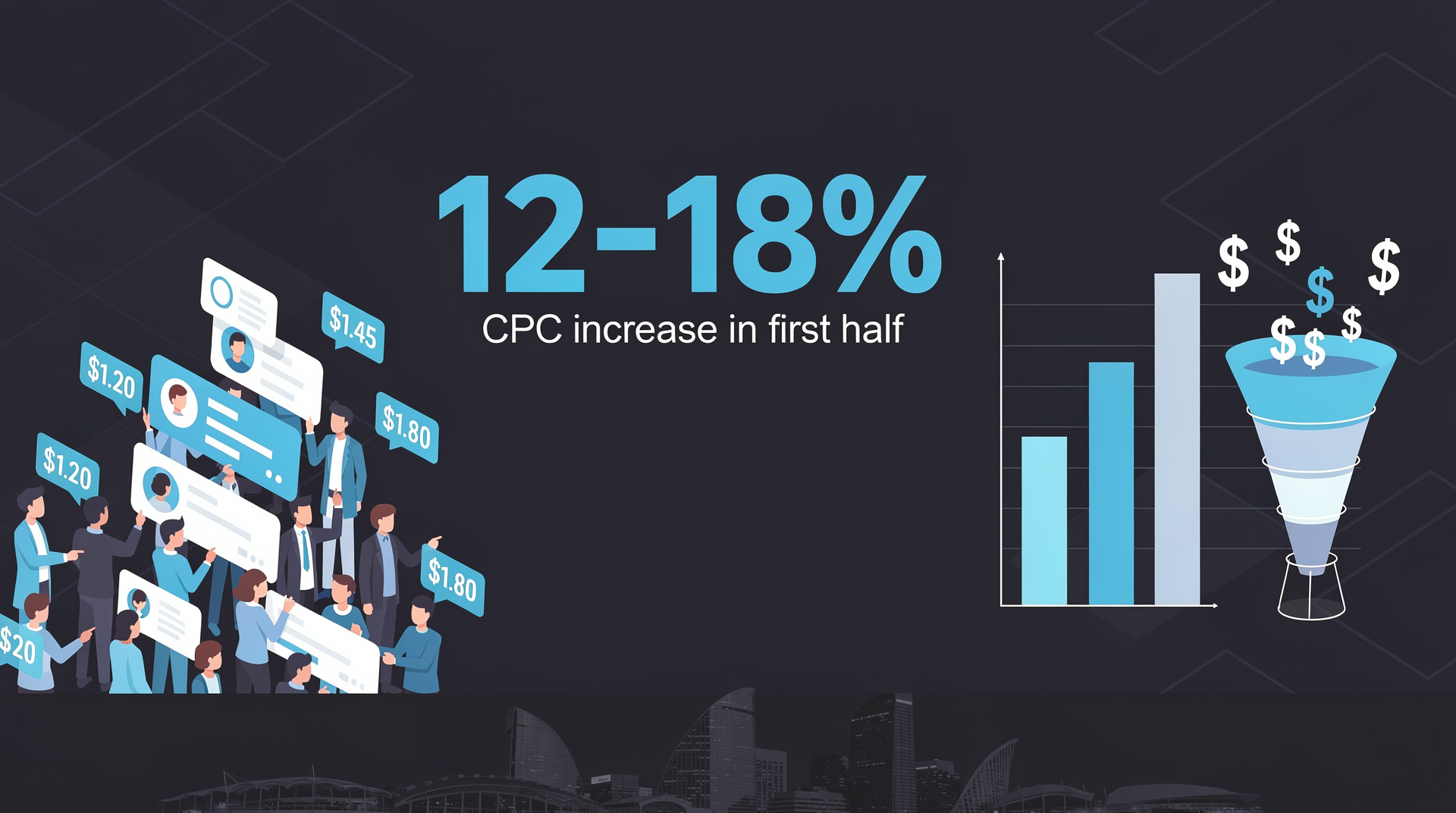
Google Ads in Singapore is not getting cheaper. CPCs across most industries climbed 12–18% in the first half of 2026, smart bidding now runs 86% of all active campaigns, and Google is pushing Performance Max harder than ever. For Singapore SMEs and agencies managing local budgets, small missteps compound fast in a market this compact.
How Much Are Dead Leads Costing You?
Every lead that doesn't pick up costs you real money. Here's exactly how much.
5 leads ghosted. S$1,000 burnt.
Your dashboard says S$200 per lead. You are actually paying S$300. The difference is fake leads reaching Google before anyone catches them.
Start Free TrialNumbers are estimates based on your inputs. Your actual results depend on campaign setup and lead volume.
This guide gives you the real benchmarks, the correct bidding progression, and the structural decisions that separate campaigns that scale from campaigns that drain budget.
Part 1: Singapore CPC and CPL Benchmarks for 2026
Search CPC by Industry (SGD)
Here are consolidated 2026 Singapore CPC ranges across the major verticals:
| Industry | Avg Search CPC (SGD) | Key Context |
|---|---|---|
| Legal Services | S$5.50 – S$8.00 | Single retained client worth 5–6 figures |
| Beauty, Wellness & Fitness | S$5.50 – S$12.50 | High local search volume; treatment offers convert well |
| IT Services & Technology | S$4.00 – S$11.00 | Cybersecurity and managed services at top of range |
| B2B Software & SaaS | S$4.00 – S$10.00 | Long enterprise sales cycles; demo conversions |
| Construction & Home Services | S$4.00 – S$9.00 | High-value renovation projects; crowded auction |
| Healthcare & Medical | S$2.50 – S$8.50 | MOH advertising guidelines restrict certain search terms |
| Finance & Insurance | S$3.50 – S$6.50 | MAS-regulated advertisers; product CLV is very high |
| Real Estate & Property | S$2.00 – S$6.50 | CEA regulations shape copy; transaction values are enormous |
| Education & Training | S$2.50 – S$12.00 | Wide band — enrichment centres vs private schools vs courses |
| Travel & Hospitality | S$1.50 – S$4.00 | Strong seasonality; demand-driven spikes |
| F&B / Restaurants | S$1.00 – S$4.00 | Best used for delivery, catering, event bookings |
| Retail & E-commerce | S$0.50 – S$2.00 | Shopping campaigns often more efficient than Search |
The 12–18% CPC rise is structural, not temporary. More advertisers are bidding on the same Singapore search terms, and Google's AI bidding layers drive up auction competition regardless of whether you use smart bidding yourself.
Cost Per Lead (CPL) by Industry (SGD)
| Industry | Typical CPL (SGD) |
|---|---|
| Legal Services | S$120 – S$300 |
| Finance & Insurance | S$100 – S$250 |
| IT Services & Technology | S$80 – S$190 |
| Professional Services | S$80 – S$180 |
| B2B Software & SaaS | S$70 – S$180 |
| Construction & Home Services | S$60 – S$160 |
| Logistics & Manufacturing | S$60 – S$150 |
| Real Estate & Property | S$50 – S$140 |
| Healthcare & Medical | S$50 – S$130 |
| Education & Training | S$35 – S$100 |
| Beauty, Wellness & Fitness | S$30 – S$70 |
| Retail & E-commerce | S$15 – S$45 |
Monthly Budget Reality Check (Including Agency Fees + 9% GST)
| Growth Stage | Media Spend | Management Fee | Total/Month (SGD) |
|---|---|---|---|
| Starter (testing) | S$1,000 – S$3,000 | S$500 – S$1,000 | ~S$1,590 – S$4,270 |
| Growth (real lead volume) | S$3,000 – S$7,000 | S$1,000 – S$2,500 | ~S$4,270 – S$10,130 |
| Aggressive (market share) | S$7,000 – S$15,000+ | S$2,500 – S$5,000 | ~S$10,130 – S$21,350+ |
Calculate Your Break-Even CPL Before Setting a Budget
Do not set a Google Ads budget based on what feels comfortable. Calculate it:
- Max acceptable CPL = Average contract value × gross margin × close rate
- Clicks required = Monthly lead target ÷ landing page conversion rate
- Media spend = Required clicks × industry average CPC
- Total cost = Media spend × 1.09 (GST) × 1.15 if using an agency
Singapore worked example — renovation company: Target is 20 qualified leads per month at a maximum CPL of S$120. Landing page converts at 5%, so you need 400 clicks. At an average CPC of S$6.00, that is S$2,400 in media spend. Add GST and a modest agency fee and the total sits around S$3,000 per month. Any budget set below this will not hit the lead target.
Part 2: Bidding Strategy — The Correct Progression
The single most common mistake in Singapore accounts: jumping to Target CPA on a cold campaign. Smart bidding is only as smart as the conversion data feeding it.
The Bidding Ladder
| Strategy | Optimises For | Min Conversions Needed | Best Used When |
|---|---|---|---|
| Manual CPC | Clicks at your chosen price | None | Brand new campaigns, tiny budgets, keyword CPC testing |
| Maximize Clicks | Click volume | None | Top-of-funnel awareness, new site needing data |
| Maximize Conversions | Conversion volume | 0 (15+ improves results) | Launching any campaign — Google's own recommendation from day one |
| Target CPA | Cost per conversion at your target | 30+ per month | After Maximize Conversions phase; consistent conversion history |
| Maximize Conversion Value | Total revenue from conversions | 30+ per month | E-commerce or when leads carry different monetary values |
| Target ROAS | Return on ad spend | 50+ per month | E-commerce with accurate conversion values and mature data |
The Right Progression for Singapore Lead Gen Campaigns
Phase 1 (0 to 30 conversions): Maximize Conversions
  ↓ Hit 30 conversions in any 30-day window
Phase 2: Add a Target CPA to Maximize Conversions
  (Google chases volume but respects your cost ceiling)
  ↓ Consistently reaching 50+ conversions per month
Phase 3 (e-commerce only): Shift to Target ROAS
Setting Target CPA before 30 conversions starves the campaign of impressions. Google's algorithm needs signal volume before it can accurately predict which users will convert.
Target CPA vs Target ROAS — The Short Version
Target CPA suits lead generation where every conversion is treated as equal. Set your target 10–15% above your current average CPA first, then tighten gradually. Setting it too aggressively below current performance restricts impressions immediately.
Target ROAS suits e-commerce and subscription businesses where different conversions carry different revenue values. It requires 50+ conversions per month before it becomes reliable.
The silent killer for Singapore smart bidding: If your conversion data contains spam form fills, competitor bot submissions, or fake property enquiries, every automated strategy — Maximize Conversions, Target CPA, Target ROAS — learns from corrupt signals. Google optimises toward the audience most likely to submit junk. This is not a theoretical risk. In Singapore's property and renovation verticals, where a single campaign can receive dozens of fake leads per week, unfiltered conversion data actively degrades smart bidding performance over time.
Part 3: Search Campaigns vs Performance Max
Side-by-Side Comparison
| Dimension | Search Campaigns | Performance Max |
|---|---|---|
| Ad placement | Google Search only | Search + Display + YouTube + Gmail + Maps + Discover |
| Targeting | Keywords you choose | AI selects audiences from your asset signals |
| Control level | High | Low — Google decides placement, format, audience |
| Typical Singapore CPC | S$1.50 – S$11.00 | S$0.30 – S$2.00 (averaged across networks) |
| Lead quality (services) | Generally higher intent | More variable — Display/Gmail leads often low intent |
| Reporting transparency | Full search term report | Limited — frequently criticised as a black box |
| Learning period | 2–3 weeks | 4–6 weeks |
| Minimum budget (SG) | S$1,000+/month | S$50/day recommended for AI to function |
When Search Campaigns Are the Right Call
- Your account has fewer than 50 conversions per month
- You are running B2B, legal, healthcare, or finance — where specific keyword intent matters
- You need to see exactly which search terms triggered your ads
- You are in the first 60–90 days of a campaign and building conversion history
When to Add Performance Max
- E-commerce with visual products that benefit from Shopping, YouTube, and Display
- Local services wanting Maps integration for broad local reach
- You already have 50+ clean monthly conversions and want to scale beyond Search
- Search campaigns are profitable and you want incremental volume
The Hybrid Approach Outperforms Either Alone
Analysis across 247 Google Ads accounts with combined spend of US$18.7 million found that accounts running both Search and Performance Max strategically averaged a 5.9% conversion rate and 5.1:1 ROAS — beating either approach alone by 23–38%.
Recommended Singapore budget split for lead generation:
- 60–80% to Search: High-intent brand terms, competitor terms, specific service searches
- 20–40% to Performance Max: Broad acquisition, Display retargeting, scaling after Search proves the CPL
Setting Up Performance Max for Lead Generation Without Getting Burned
The most common PMax failure mode: Google optimises toward easy conversions — Display form fills and Gmail clicks — that look like leads but are not qualified. This is a serious problem for Singapore property, renovation, and education advertisers where a single bad month of PMax leads can contaminate months of smart bidding data.
To run PMax for lead gen correctly:
- Feed back qualified lead signals — integrate your CRM so Google learns from sales-qualified leads, not just raw form fills
- Set campaign-specific conversion goals rather than account-wide goals that PMax can cherry-pick from
- Upload customer match lists — phone numbers and emails of past buyers give PMax a real lookalike audience to target
- Exclude brand terms at the campaign level to stop PMax cannibalising your branded Search traffic
- Apply negative keywords — PMax does honour campaign-level negatives despite its automated nature
- Respect the 4–6 week learning period before making budget or target changes
Part 4: Campaign Structure Principles That Hold in 2026
One Theme Per Ad Group
Every ad group should contain keywords similar enough in meaning that any of them could logically appear in a headline. This directly improves Quality Score, which lowers your effective CPC in Singapore's expensive auctions.
Negative Keywords Are Non-Negotiable
Review your Search Terms Report every 48–72 hours for the first month of any new campaign. This single habit consistently saves more budget than any other optimisation action.
Structure your negatives at three levels:
- Campaign level: Terms that should never trigger any ad in this campaign — examples include "free", "jobs", "DIY", "how to"
- Ad group level: Terms that belong to a different ad group's audience
- Shared negative lists: Build reusable lists labelled "Job Seekers", "Competitors", "DIY Searches" and apply them across all campaigns
The Spam Lead Problem in Singapore Campaigns
This is where campaign structure alone cannot protect you. A renovation advertiser paying S$6.00 per click with a 5% form conversion rate is already paying S$120 per lead. If 30% of those leads are spam, the true CPL on genuine leads is S$171 — and Target CPA is learning to find more people who submit fake enquiries.
LeadsOff filters spam submissions at the conversion event level, before they are sent to Google as training data. That means your Target CPA and Maximize Conversions strategies learn from real buyers — not bots, not competitors doing competitor research, not accidental submits.
Key Takeaways
takeaways
- Singapore CPCs rose 12–18% in 2026 across most verticals — legal and wellness sit above S$8.00 average
- Do not set Target CPA until you have 30 genuine conversions in 30 days — below this, the campaign restricts its own impressions
- 86% of campaigns now use automated bidding — clean conversion data is no longer optional, it is the foundation everything else runs on
- Performance Max underperforms for B2B and services lead gen when run without CRM signal feedback and negative keyword exclusions
- The hybrid Search + PMax structure outperforms either alone by 23–38% in conversion rate and ROAS, but only when conversion data is clean
- In Singapore's property and renovation verticals, 20–35% of raw form submissions are not genuine leads — this directly corrupts smart bidding over time
:::
If your Singapore Google Ads account is running smart bidding on unfiltered conversion data, you are not optimising toward better customers. You are training Google to find more of whoever is submitting your forms — including the fakes. Fix the data layer first, then optimise the bidding strategy.

The LeadsOff team builds spam-blocking infrastructure for Google Ads lead forms across Singapore. Our articles are drawn from live campaign data, client blocklist patterns, and direct analysis of how fake leads corrupt Smart Bidding. We publish when we have something real to say.
LeadsOff catches the fake leads Google can't. Setup in 30 minutes.
Get Started →