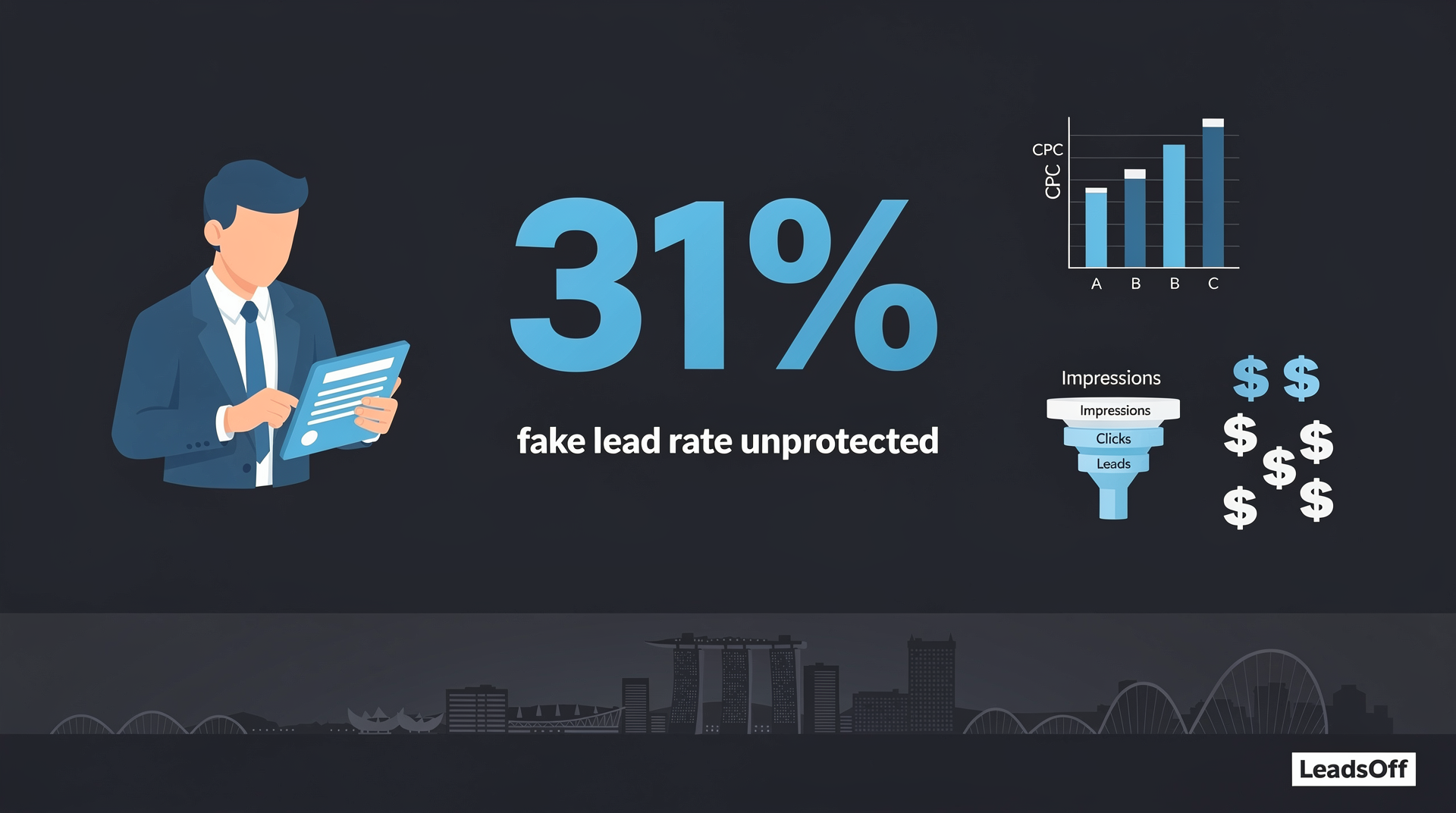
Most Singapore advertisers running Google Ads are using the right tools — and still getting the wrong results. The optimisation stack looks complete: bid management, keyword tracking, analytics dashboards. But if fake leads are entering your conversion data, every tool in that stack is optimising toward the wrong signal.
How Much Are Dead Leads Costing You?
Every lead that doesn't pick up costs you real money. Here's exactly how much.
5 leads ghosted. S$1,000 burnt.
Your dashboard says S$200 per lead. You are actually paying S$300. The difference is fake leads reaching Google before anyone catches them.
Start Free TrialNumbers are estimates based on your inputs. Your actual results depend on campaign setup and lead volume.
The best campaign optimisation tool in the world cannot fix a corrupted data feed. If Google's Smart Bidding is learning from fake conversions, you are not optimising — you are accelerating in the wrong direction.
Why Optimisation Tools Fail When the Underlying Data Is Wrong
Search engine ad optimisation tools — from Google's own recommendations engine to third-party platforms like Optmyzr, WordStream, and SEMrush — all share the same dependency: they trust your conversion data. Feed them clean data, they perform well. Feed them corrupted data, they optimise your campaign to find more of the wrong people, faster.
The core issue is that most Singapore advertisers conflate three fundamentally different problems:
Type 1 — Bot submissions: Automated, high-volume form fills. Fast, repetitive, easily caught by reCAPTCHA and most click fraud tools. These are largely solved.
Type 2 — [Competitor or human fraud](https://leadsoff.com/blog/why-youre-getting-fake-leads-from-google-ads-and-how-to-stop-it): Real people — a competitor's employee, a disgruntled ex-customer, someone testing your sales process — deliberately submitting fake enquiries. They browse naturally, use residential Singapore IPs, and pass every bot filter. No optimisation tool touches this.
Type 3 — Low-intent traffic: Real searchers who clicked your ad but never intended to buy. Inflated by broad match, AI Max campaigns, and Search Partners. Not fraud — but equally damaging to Smart Bidding accuracy.
The most dangerous for your campaign is Type 2. It looks identical to a genuine conversion. And it is the type that every standard optimisation tool, including Google's own, is completely blind to.
Why Common Fixes Don't Actually Work
When CPL rises and lead quality drops, Singapore marketing managers typically cycle through a predictable set of fixes. Each one addresses a real problem — just not the right one.
Add reCAPTCHA to your forms
reCAPTCHA stops automated bots, often in under two seconds. It was designed for automation detection — not for a competitor's sales coordinator manually filling your enquiry form during lunch. A human submitting a fake lead passes every reCAPTCHA check because they are, in fact, human. This fix eliminates Type 1 noise and nothing else.
Install a click fraud detection tool
Click fraud tools like ClickCease or TrafficGuard work by identifying suspicious click patterns — rapid repeat clicks, known bot IP ranges, data centre traffic. They are effective at preventing fraudulent clicks from becoming fraudulent conversions. But a human competitor clicks once, normally, from a residential Tampines IP address. No pattern anomaly. No flag. They land on your page, scroll for 90 seconds, and fill your form. The tool recorded nothing unusual because nothing unusual happened — yet.
Exclude known competitor IP addresses
IP exclusion assumes competitors use static, identifiable office IPs. Most do not. A competitor submitting a fake enquiry from a home connection, a mobile device, or a VPN exit node is invisible to IP exclusion. Google Ads also caps manual IP exclusions at 500 addresses — insufficient for any sustained human fraud campaign.
Tighten keyword match types
Switching from broad match to exact match reduces low-intent traffic (Type 3) meaningfully. It will not stop a human who searched your brand name or your exact service keyword before submitting a fake lead. Match type tightening is a legitimate optimisation lever — but it solves a different problem entirely.
| What Google Analytics shows | What is actually happening |
|---|---|
| Normal session duration and scroll depth | A real person deliberately filling time before submitting |
| Residential Singapore IP address | Could be home connection, mobile, or VPN exit node — indistinguishable |
| Form submitted with plausible contact details | Fake domain, dead inbox, or a number that rings once and disconnects |
| Conversion recorded, Smart Bidding updated | Algorithm now targets more audiences who behave exactly like your competitor's employee |
The Gap Nobody Closes
Here is the sequence that plays out silently inside thousands of Singapore ad accounts every month:
Bot click → BLOCKED by click fraud tool
Competitor employee clicks → passes → lands on your page
→ scrolls naturally, waits 90 seconds, fills form with plausible details
→ NOTHING in your current optimisation stack stops this
→ Google records conversion → Smart Bidding: find more people like this
→ Bidding model shifts toward wrong audience segments
→ CPL rises 35–50%. Lead quality drops. You brief your agency.
→ Agency tightens keywords, adjusts bids, refreshes ad copy.
→ Problem persists. You blame the market or the platform.
The gap is not in your ad copy, your keyword strategy, or your landing page. The gap is between what Google records as a conversion and what your sales team actually qualifies as a lead. Standard optimisation tools operate entirely upstream of that gap.
What Actually Works
The fix is not a better bid management tool or a smarter keyword planner. It is conversion-level filtering — the ability to identify and exclude individual fake conversions before they are fed to Smart Bidding as positive signals.
This is the mechanism LeadsOff uses. Rather than blocking clicks (which misses human fraud entirely), it analyses each submitted lead against a set of signals — email domain validity, phone number format and carrier data, submission behaviour patterns, and cross-campaign fingerprinting — and flags leads that do not pass qualification before they reach your Google Ads conversion data.
Before: Your renovation campaign records 90 conversions in a month. Nineteen are competitor test submissions. Smart Bidding spends the next learning cycle finding more audiences that look like those nineteen people.
After: LeadsOff flags those nineteen before they are logged as conversions. Smart Bidding sees 71 verified buyer signals instead of 90 mixed signals. Over the next two learning cycles — roughly three to four weeks — CPL drops and pipeline quality recovers.
For Singapore SMEs spending S$5,000–S$15,000 per month on Google Ads, the compounding effect of clean conversion data is worth more than any bid adjustment or keyword restructure.
A 20% reduction in fake conversions delivered to Smart Bidding will outperform a 20% increase in ad spend almost every time — because it changes what the algorithm is optimising toward, not just how hard it is optimising.
If you want to understand how different campaign structures interact with this problem, it is worth exploring how AI Max and broad match campaigns amplify fake lead exposure — the volume dynamics are meaningfully different from standard search campaigns.
Clean conversion data fed to Smart Bidding is worth more than any optimisation tool layered on top of corrupted data. Fix the input before you adjust the settings.
Signs This Is Already Happening to Your Campaign
- Your CPL has risen 30–50% without any targeting changes — If cost per lead has climbed steadily over six to ten weeks without a corresponding change in competition or keyword costs, Smart Bidding has likely entrenched a corrupted audience model. The algorithm is not underperforming — it is performing exactly as trained, toward the wrong people.
- Your sales team answer rate is below 40% — When sales follow up on form enquiries and fewer than four in ten contacts respond, the submissions are not coming from people who intended to buy. Either low-intent traffic or deliberate fake submissions are inflating your conversion count.
- Conversions look healthy in Google Ads but the pipeline is empty — This is the clearest diagnostic signal. If your campaign dashboard shows a stable conversion rate but your CRM shows nothing progressing past first contact, the disconnect is almost always in the quality of what is being recorded as a conversion.
- Performance declined after a Smart Bidding learning phase — If a campaign performed well initially, then deteriorated after the learning phase completed, fake conversions were baked into the baseline model during the period when the algorithm was most receptive to new signals. The learning phase is when data quality matters most.
The Singapore Version of This Problem
Singapore's ad market has specific characteristics that make human fake lead fraud more damaging than in larger markets.
The total addressable market for most Singapore SME verticals is small. A renovation company targeting HDB homeowners is competing in a market of perhaps 80,000–120,000 relevant households. A property agency running ads for new launches is targeting a few thousand actively searching buyers at any given time. When fake leads pollute Smart Bidding data in a small-signal environment, the corruption compounds faster — there are fewer genuine conversions to dilute it.
Industry CPL benchmarks in Singapore reflect this pressure. In financial services, qualified lead CPL ranges from S$180 to S$380. In education, S$60 to S$140. In renovation and property, S$90 to S$250 depending on campaign structure. Even three to five fake conversions per week at these CPL levels represents S$1,500 to S$6,000 in wasted monthly spend — before accounting for the downstream Smart Bidding damage.
There is also a PDPA dimension that most Singapore advertisers have not considered. When a competitor submits a fake lead using a third party's personal details — a real name, a real mobile number, a real email address — that data enters your CRM and your remarketing lists without the subject's consent. If that data is used for follow-up marketing, you are potentially processing personal data without a valid legal basis under the Personal Data Protection Act. Fake leads are not just a budget problem. They create compliance exposure.
Singapore's Search Partners traffic adds another layer. Google's Search Partners network — which includes local classified and comparison sites — delivers higher fake lead rates than core Google Search in most Singapore verticals. Disabling Search Partners is a standard first step, but it does not address human fraud arriving through core search.
| Fix | Stops Bots | Stops Human Fake Leads | Protects Smart Bidding Data |
|---|---|---|---|
| reCAPTCHA | ✓ | ✗ | ✗ |
| Click fraud tool | ✓ | ✗ | ✗ |
| IP exclusion | ✓ | ✗ | ✗ |
| Tighter keyword match types | ✗ | ✗ | Partial |
| Disable Search Partners | ✗ | Partial | Partial |
| Conversion-level lead filtering | ✗ | ✓ | ✓ |
Frequently Asked Questions
what are the best tools to optimise search engine ad campaigns in Singapore
The most impactful tools depend on what is corrupting your results. Bid management platforms like Optmyzr or Google's own recommendations engine improve efficiency — but only when fed clean conversion data. If human fake leads are entering your Smart Bidding data, no optimisation tool will fix the underlying problem. Conversion-level lead filtering, which flags fake submissions before they reach Google, has more measurable impact on CPL than any bid adjustment tool for most Singapore SMEs.
does recaptcha stop fake leads on Google Ads forms
reCAPTCHA stops automated bot submissions reliably. It does not stop a real person deliberately submitting a fake enquiry — a competitor's employee, for example, passes every reCAPTCHA check because they are human. For Google Ads specifically, the more damaging fake leads are human-submitted, because they are recorded as legitimate conversions and corrupt Smart Bidding data. reCAPTCHA solves roughly half the fake lead problem at best.
how many fake leads does it take to damage Smart Bidding
Smart Bidding can begin shifting its audience model after as few as five to ten corrupted conversions in a single learning cycle, which typically runs two to four weeks. In Singapore's smaller verticals — renovation, education, financial services — where monthly conversion volumes are often 30 to 80 total, even three to five fake leads per week represent a 15–25% signal corruption rate. The learning phase is when the damage is most severe, because the algorithm is actively recalibrating toward whatever it sees.
is competitor fake lead fraud a common problem in Singapore Google Ads
It is more common in Singapore than most advertisers acknowledge, partly because the total addressable market in most verticals is small enough that individual competitors have strong incentive to disrupt rivals' campaigns. Property, renovation, financial services, and education campaigns are the most frequently affected categories. Because human fake leads pass every standard bot filter and look identical to genuine conversions in Google Analytics, most advertisers attribute the resulting CPL rise to market conditions rather than deliberate fraud.
what should I do instead of relying on click fraud tools for fake leads
Click fraud tools are worth running for bot protection, but they should not be your only defence. The gap they cannot close is human-submitted fake leads — deliberate form fills by real people that pass every behavioural and IP check. Conversion-level filtering, which analyses each submitted lead for signals like email domain validity, phone carrier data, and cross-campaign patterns before logging it as a Google Ads conversion, is the only approach that protects Smart Bidding data from this type of fraud. Disabling Search Partners and tightening keyword match types reduce low-intent volume, but neither addresses deliberate human fraud.
Worried about spam leads corrupting your Google Ads data? LeadsOff catches fake conversions before they teach Smart Bidding the wrong thing. Start free at leadsoff.com — no credit card, setup in under 5 minutes.

The LeadsOff team builds spam-blocking infrastructure for Google Ads lead forms across Singapore. Our articles are drawn from live campaign data, client blocklist patterns, and direct analysis of how fake leads corrupt Smart Bidding. We publish when we have something real to say.
LeadsOff catches the fake leads Google can't. Setup in 30 minutes.
Get Started →