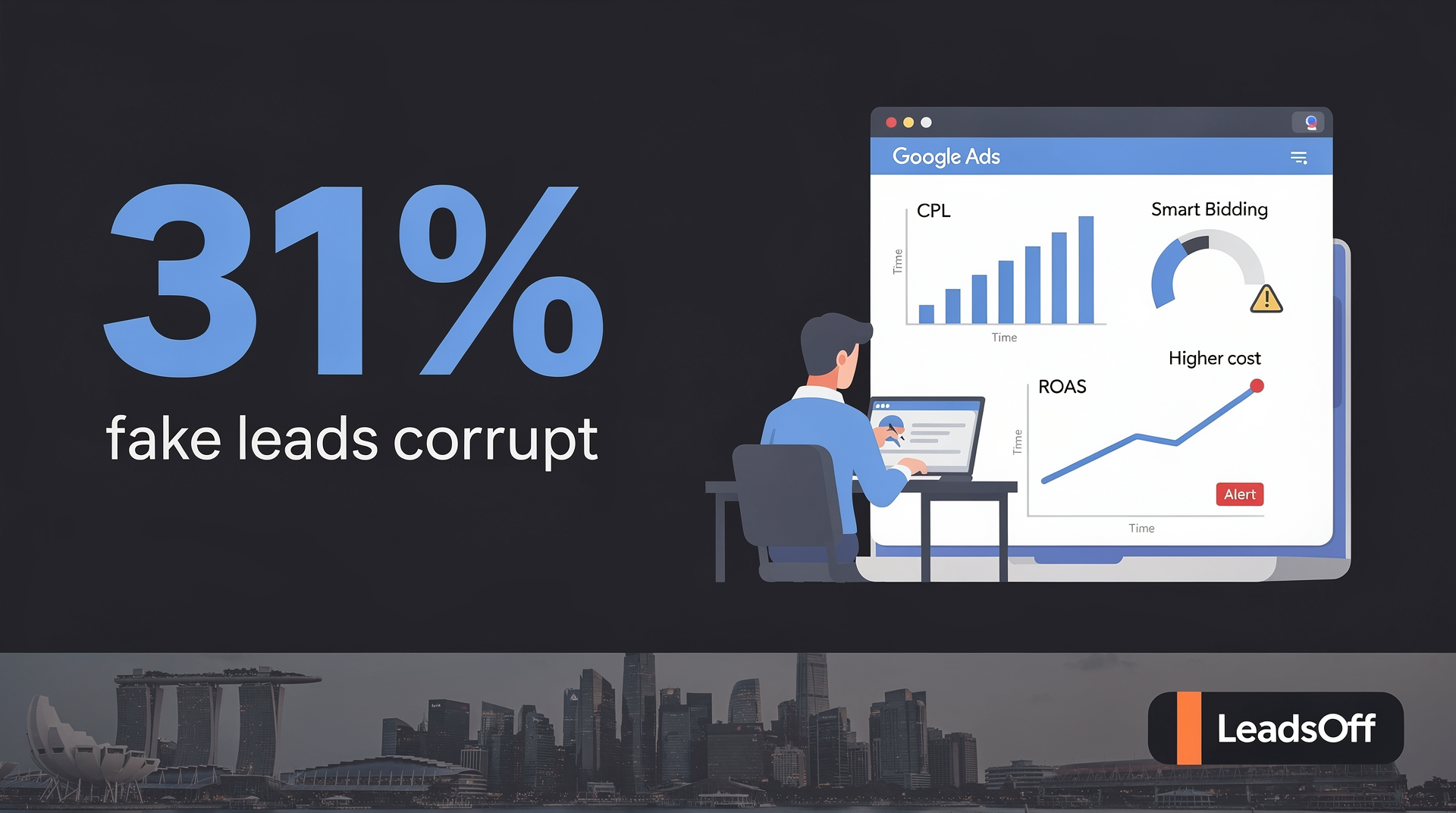
One fake lead submitted to your Google Ads campaign is not a nuisance. It is a training signal — and Google's AI just learned from it.
How Much Are Dead Leads Costing You?
Every lead that doesn't pick up costs you real money. Here's exactly how much.
5 leads ghosted. S$1,000 burnt.
Your dashboard says S$200 per lead. You are actually paying S$300. The difference is fake leads reaching Google before anyone catches them.
Start Free TrialNumbers are estimates based on your inputs. Your actual results depend on campaign setup and lead volume.
Smart Bidding does not know the difference between a competitor filling your form and a genuine buyer. It treats every recorded conversion as evidence of what a good customer looks like. Feed it enough bad examples and it will optimise your entire budget toward the wrong audience.
Why Does One Fake Lead Actually Damage Your Campaign?
Smart Bidding — whether you are running Target CPA, Target ROAS, or Maximise Conversions — builds a predictive model around your conversion history. Every recorded conversion tells the algorithm: the person who clicked this ad, from this location, at this time, using this device, with this search behaviour — that person converted. Find more like them.
A human competitor submitting a fake enquiry looks identical to a real buyer at the signal level. They have a Singapore residential IP. They spend a plausible amount of time on your landing page. They scroll. They fill in the form with enough detail to pass validation. Google records a conversion. The model updates.
This is not a bot problem. Bots are fast, mechanical, and detectable. The fake leads that damage Smart Bidding the most are type 2: deliberate human fraud — a competitor's employee, a disgruntled ex-client, or someone paid to waste your budget. They behave like real users because they are real users. And your bidding model cannot tell them apart from your best customers.
Type 3 — low-intent traffic from broad match or Search Partners — also corrupts the model, but in a slower, diffuse way. Human fraud is surgical and cumulative. Each submission compounds the previous one.
Why Do Common Fixes Fail Against Human Fake Leads?
Most Singapore advertisers who discover fake leads in their pipeline reach for the same set of tools. None of them were designed for this problem.
Add reCAPTCHA to your forms
reCAPTCHA stops bots in under two seconds. A competitor's employee filling the form manually passes every check. reCAPTCHA analyses mouse movement, keypress timing, and interaction patterns — all of which a human produces naturally. It was designed for automation, not deliberate human sabotage. Adding it to your form changes nothing for type 2 fraud.
Exclude competitor IP addresses
IP exclusion works when the submitter is on a fixed office IP. A competitor using their home broadband, a mobile connection, or a VPN exit node in Jurong is indistinguishable from a genuine prospect. You would need to know the IP in advance to exclude it — which you never do. Singapore's relatively small pool of commercial IP ranges makes this especially unreliable.
Use a click fraud detection tool
Click fraud tools flag suspicious click patterns before someone reaches your landing page. They are good at catching bot click farms and repeat clicking from the same IP. They do not monitor what happens after the click. A competitor who clicks once, behaves normally on the page, and submits a form with plausible details generates zero signals that any click fraud tool can act on.
Filter leads manually in the CRM
Some advertisers mark bad leads as junk in HubSpot or Salesforce and assume that cleans the data. It cleans your CRM. It does not clean Google's conversion history. If the conversion was already sent to Google Ads before you marked it bad, the damage to the bidding model is already done. Manual CRM filtering is retrospective; Smart Bidding corruption is real-time.
| What Google Analytics shows | What is actually happening |
|---|---|
| Natural scroll depth and time on page | A real person deliberately filling time to appear genuine |
| Residential Singapore IP address | Could be a VPN exit node — indistinguishable from a real buyer |
| Form submitted with valid-looking details | Fake domain, dead inbox, or a competitor test submission |
| Conversion recorded, CPL looks healthy | Smart Bidding model quietly shifting toward the wrong audience |
The Gap Nobody Closes
Here is what actually happens when a competitor submits a fake lead — step by step:
Bot click → BLOCKED by click fraud tool

Competitor employee clicks → passes click fraud check → lands on your page
→ scrolls naturally, waits 90 seconds, fills form with plausible details
→ NOTHING in your current stack stops this
→ Google records conversion → Smart Bidding: "find more like this person"
→ Bidding model shifts toward the wrong audience segment
→ CPL rises 20–40% over next 3–4 weeks
→ You change keywords, adjust bids, test new creatives
→ Nothing works — because the problem is in the training data, not the ads
This is the gap. Click fraud tools guard the door. reCAPTCHA guards the form. Nothing guards the conversion signal itself — the moment a fake submission is transmitted to Google as a real buyer event.
Your competitor is not a bot. They look human because they are human — and every tool in your current stack was designed for bots, not people.
What Actually Works Against Human Fake Leads?
The only intervention that protects Smart Bidding is one that happens before the conversion is sent to Google — not after the click, and not after the CRM receives the lead.
This requires evaluating the lead itself: the submission pattern, the contact data quality, the domain, the timing relative to your ad schedule, and cross-referencing against known fraud signals specific to your industry and market. A property campaign in Singapore has a different fraud fingerprint than an education lead gen campaign.
LeadsOff intercepts each lead between your form and your Google Ads conversion tag. If the lead is flagged as fraudulent, the conversion event is suppressed — Google never sees it. Smart Bidding continues to learn, but only from verified, real enquiries.
Before: Your renovation campaign records 80 conversions a month. 24 of them are competitor test submissions and deliberate fake enquiries. Smart Bidding trains on 80 signals — one in three of which points to the wrong person.
After: LeadsOff filters those 24 before they reach Google. Smart Bidding sees 56 verified buyers. CPL drops S$18 over the next learning cycle. Sales team answer rate improves from 38% to 61% because every number in the pipeline belongs to someone who actually wants a quote.
The fix is not better ads. It is cleaner data. Smart Bidding is only as accurate as the conversions you feed it.
If you want to understand the full scope of how lead quality affects your campaign economics, it is worth exploring how Smart Bidding learning phases interact with conversion volume — because cleaning your data also affects how frequently Google's model resets.
One human fake lead submitted this morning will still be influencing your bidding model four weeks from now — long after you have forgotten about it.
Signs This Is Already Happening to Your Campaign
- Your CPL has risen 30–50% without any targeting changes — You have not touched match types, bid strategies, or audience layers, but cost per lead has climbed steadily over six to eight weeks. This is the signature of a corrupted bidding model, not a market shift. When Smart Bidding trains on fake conversions, it bids more aggressively for the wrong traffic — and that traffic does not convert.
- Your sales team's answer rate is below 40% — In Singapore, a healthy answer rate on inbound leads sits between 60–75%. If your team is reaching fewer than four in ten people who submitted a form, a significant portion of those contacts are fake. Real buyers pick up the phone. Fake submissions do not.
- Conversions look healthy in Google Ads but pipeline is empty — This is the most dangerous pattern because it delays the diagnosis. Your dashboard shows a CPL of S$45 and a conversion rate of 8%. Your sales director is asking why nobody is closing. The disconnect between reported conversions and actual pipeline is almost always a data quality problem.
- Performance deteriorated immediately after a Smart Bidding learning phase — Learning phases should improve performance as the model stabilises. If your CPL spiked or lead quality dropped in the two to three weeks after a learning phase completed, the model finished training on bad data. It is now operating with high confidence in the wrong direction.
The Singapore Version of This Problem
Singapore's Google Ads market has specific characteristics that make human fake lead fraud more damaging than in larger markets.
Competitor density is high and market segments are small. In property, renovation, and education, five to fifteen advertisers are often competing for the same few thousand monthly searches. The incentive to corrupt a competitor's bidding model is real, and the cost of doing so — a few minutes of a staff member's time — is negligible compared to the disruption caused.
Singapore CPL benchmarks make the damage measurable. Property leads run S$80–S$180 per conversion. Financial services leads reach S$120–S$250. If 30% of your recorded conversions are fake, you are not just wasting that CPL — you are using it to actively degrade your remaining budget.
There is also a PDPA compliance dimension that most advertisers overlook. Fake submissions that enter your CRM create records of individuals who never consented to being contacted. If your team calls or emails those contacts — as most follow-up sequences automatically do — you are potentially contacting people under fabricated consent. The Personal Data Protection Act 2012 applies to data you hold, regardless of how it arrived. Fake leads are not just a budget problem; they are a data governance problem.
F&B and healthcare campaigns face a variation of this — low-intent traffic from Search Partners and broad match inflating conversion counts. This is type 3 fraud: not deliberate, but equally damaging to Smart Bidding accuracy. Singapore's small geographic targeting radius means Search Partners often serve ads to audiences outside your actual service area, further diluting signal quality.
| Fix | Stops Bots | Stops Competitor Human Fraud | Protects Smart Bidding Data |
|---|---|---|---|
| reCAPTCHA | ✓ | ✗ | ✗ |
| IP exclusion | ✓ | ✗ | ✗ |
| Click fraud detection tool | ✓ | ✗ | ✗ |
| Manual CRM filtering | ✗ | ✗ | ✗ |
| Conversion-level lead filtering (LeadsOff) | ✗ | ✓ | ✓ |
Frequently Asked Questions
how many fake leads does it take to mess up google ads smart bidding
Smart Bidding can begin shifting its model after as few as three to five corrupted conversions within a single learning cycle, which typically spans two to four weeks. The impact compounds — each fake conversion reinforces the previous one, gradually pulling the audience targeting toward people who look like the fraudster rather than your real buyers. By the time you notice CPL rising, the model has already been reinforcing the wrong signals for weeks.
does recaptcha stop fake leads on google ads forms
reCAPTCHA stops automated bot submissions but has no effect on human fake leads — deliberate form fills made by real people. A competitor employee submitting a fake enquiry moves the mouse, types naturally, and passes every reCAPTCHA challenge without triggering any flags. For Google Ads campaigns where the concern is Smart Bidding corruption from fraudulent conversions, reCAPTCHA addresses only the lowest-sophistication attack vector.
why is my google ads cpl going up even though conversions look normal
Rising CPL alongside stable-looking conversion volume is the clearest sign that your Smart Bidding model is training on fake or low-quality conversions. Google's algorithm is confidently bidding more to reach an audience that resembles your recorded converters — but if a significant portion of those converters were fake submissions, the model is optimising toward the wrong people. Auditing lead quality at the submission level, before conversions reach Google, is the only way to diagnose and fix this.
can competitors submit fake leads to ruin my google ads campaign in singapore
Yes, and it is more common in Singapore's high-CPL verticals — property, renovation, financial services, and education — than most advertisers realise. A competitor needs no technical skill: one employee, a few minutes, and a plausible-looking form submission is enough to corrupt a conversion signal. Singapore's small advertiser pool per niche means the incentive is high and the cost of doing it is near zero.
what is the best way to protect google ads smart bidding from fake conversions
The only effective protection for Smart Bidding is intercepting fake leads before the conversion event is transmitted to Google — not after. Post-submission CRM filtering, IP exclusions, and click fraud tools all act too late or too early in the funnel to prevent the conversion signal from corrupting the model. Conversion-level filtering tools that sit between your form submission and your Google Ads conversion tag — suppressing fraudulent events before they reach the algorithm — are the only category that directly protects bidding data.
is fake lead fraud a bigger problem in singapore than other countries
Singapore's combination of high CPLs, small keyword pools, and dense competitor concentration makes human fake lead fraud disproportionately damaging compared to larger markets. When five advertisers are competing for the same 3,000 monthly searches, corrupting one competitor's Smart Bidding model has a measurable impact on market share — and the cost of doing it is a fraction of the disruption caused. The PDPA compliance risk from fake submissions entering your CRM adds a regulatory dimension that does not exist in most other markets.
Worried about spam leads corrupting your Google Ads data? LeadsOff catches fake conversions before they teach Smart Bidding the wrong thing. Start free at leadsoff.com — no credit card, setup in under 5 minutes.

Founder of LeadsOff and director of KTR Projects. Built LeadsOff after watching Singapore property agencies lose thousands monthly to competitor-submitted fake leads Google couldn't catch. Focuses on Google Ads integrity across property, F&B and renovation.
LeadsOff catches the fake leads Google can't. Setup in 30 minutes.
Get Started →