- The Number That Actually Matters Is Not Your CPL
- The Baseline Problem: Invalid Traffic Is Structural, Not Accidental
- Lead Quality Master Table: Every Major Platform Side by Side
- Platform-by-Platform Spam Rate Breakdown
- Visitor-to-Lead Conversion Benchmarks by Traffic Source
- Facebook Instant Form vs Landing Page: Real Singapore Split-Test Data
- How LeadsOff Fits Into This Picture
The Number That Actually Matters Is Not Your CPL
Every Singapore marketing manager has a CPL target. Almost none of them have a cost-per-closed-deal target — and that gap is where budget goes to die.
How Much Are Dead Leads Costing You?
Every lead that doesn't pick up costs you real money. Here's exactly how much.
5 leads ghosted. S$1,000 burnt.
Your dashboard says S$200 per lead. You are actually paying S$300. The difference is fake leads reaching Google before anyone catches them.
Start Free TrialNumbers are estimates based on your inputs. Your actual results depend on campaign setup and lead volume.
A Facebook Instant Form lead in Singapore can cost S$25. A Google Search lead for the same offer might cost S$130. On the surface, Facebook wins easily. But when you trace those leads all the way to signed contracts, the picture flips — or at minimum becomes far more complicated than the CPL dashboard suggests.
This article maps spam rates, visitor-to-lead conversion rates, and lead-to-sale conversion rates across every major platform used by Singapore advertisers in 2026. Read it as a system, not a menu.
The Baseline Problem: Invalid Traffic Is Structural, Not Accidental
Before comparing any platform, you need to accept one uncomfortable truth: ad fraud is baked into digital advertising at scale. It is not an edge case.
| Metric | 2026 Global Estimate |
|---|---|
| Global ad fraud losses | S$135–160 billion annually |
| invalid traffic — open programmatic display | 12–25% |
| Invalid traffic — paid search (mature accounts) | 2–5% |
| Invalid traffic — mobile app campaigns | 5–12% |
| Finance and property lead funnels | 12–22% fraud exposure |
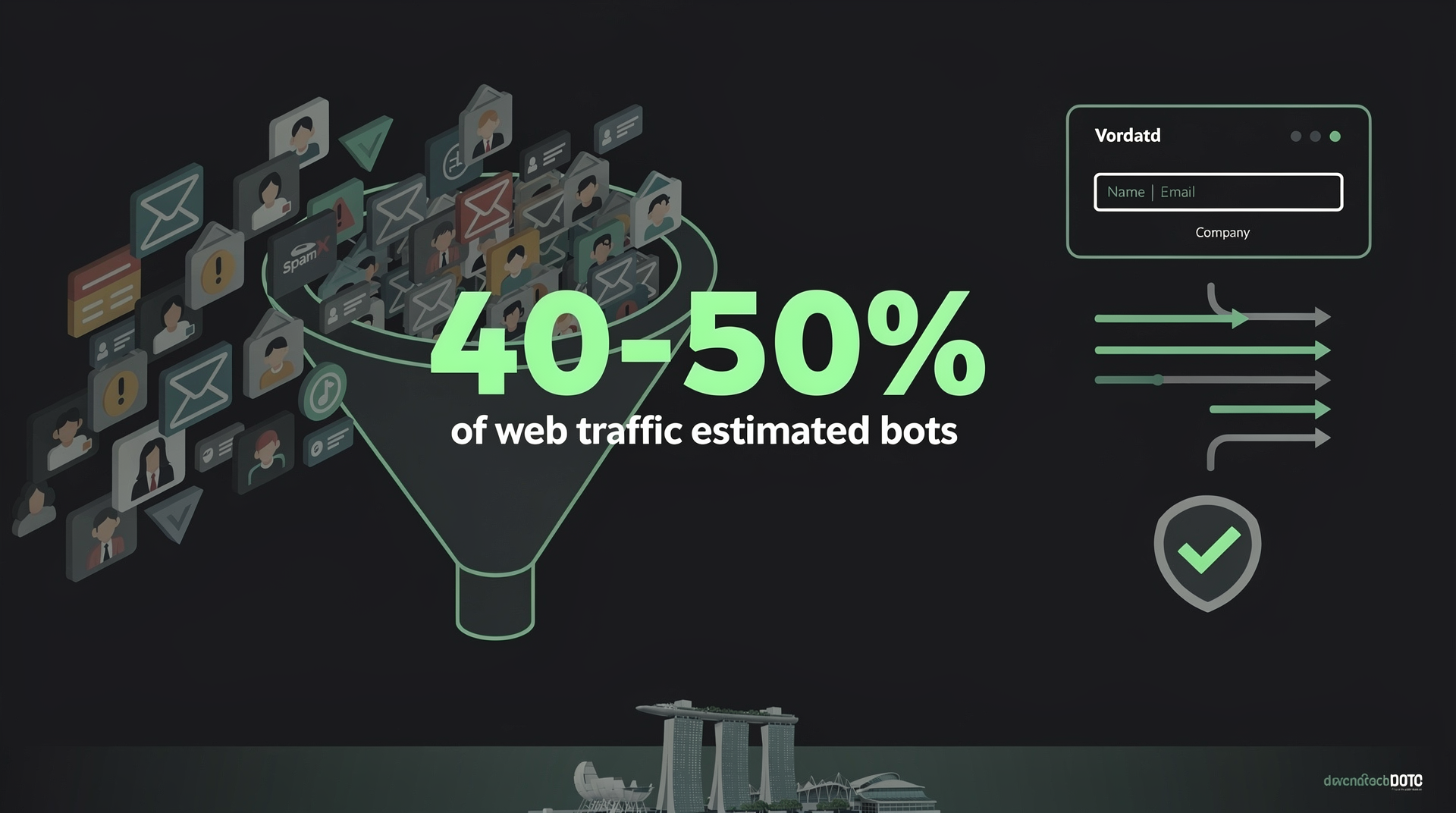
| Total web traffic estimated to be bots | 40–50% |
| CPA inflation from undetected click flooding | 10–20% |
For Singapore specifically, the verticals most exposed to invalid traffic are property, legal services, financial advisory, and renovation. These are high-CPL keywords that attract click farm operators looking to generate fraudulent conversion signals and drain competitor budgets.
The practical implication: your cost per lead is already inflated before any campaign-level analysis begins. The degree of inflation varies enormously by platform.
Lead Quality Master Table: Every Major Platform Side by Side
This is the most important reference in this article. Pay attention to the final two columns — everything else is context.
| Platform | Est. Spam Rate | Visitor-to-Lead CVR | Lead → Sale Rate | Relative Intent |
|---|---|---|---|---|
| SEO / Organic Search | 5–10% | 4.1% | 14.6% | ⭐⭐⭐⭐⭐ Highest |
| Google Search Ads | 2–5% | 2.7–5% | 7–12% | ⭐⭐⭐⭐ Very High |
| Direct Traffic | 2–5% | 3.7% | 10–15% | ⭐⭐⭐⭐ Very High |
| Email (owned list) | 3–8% | 3.0% | 8–12% | ⭐⭐⭐⭐ High |
| Referral / Word of Mouth | 2–5% | 3.3% | 15–25% | ⭐⭐⭐⭐ High |
| LinkedIn Ads | 3–7% | 1.8–3.2% | 8–15% | ⭐⭐⭐⭐ High (B2B) |
| Click-to-WhatsApp Ads | 5–12% | Conversation-based | 15–30% | ⭐⭐⭐⭐ High (SG) |
| Google Ads PMax / Display | 8–18% | 1–3% | 4–8% | ⭐⭐⭐ Medium |
| Facebook/IG → Landing Page | 8–15% | 2.4% | 5–12% | ⭐⭐⭐ Medium |
| Facebook/IG Instant Form | 15–40% | N/A (pre-fill) | 3–8% | ⭐⭐ Low-Medium |
| TikTok Ads | 15–30% | ~2% | 2–6% | ⭐⭐ Low |
| YouTube Ads | 5–12% | 1.5–3% | 3–8% | ⭐⭐ Low-Medium |
| Programmatic Display | 15–40% | <1% | <3% | ⭐ Very Low |
How to Read This as a Singapore Advertiser
Here is a worked example using numbers that reflect what Singapore renovation and property businesses actually report:
- Facebook Instant Form CPL: S$30
- Google Search CPL: S$120
- Facebook lead-to-sale rate: 5% (1 in 20 leads closes)
- Google lead-to-sale rate: 10% (1 in 10 leads closes)
Facebook [cost per closed deal](https://leadsoff.com/blog/singapore-google-ads-benchmarks--strategy-guide-2026): S$30 ÷ 5% = S$600
Google cost per closed deal: S$120 ÷ 10% = S$1,200
Facebook wins — until you factor in a 35% spam rate, which is conservative for Instant Forms in Singapore service industries:
- Adjusted effective CPL: S$30 ÷ 65% valid leads = S$46
- Adjusted close rate from valid leads: ~8%
- Adjusted Facebook cost per closed deal: S$575
The gap narrows to almost nothing. And when spam rates climb to 50% — which Singapore renovation agencies regularly report — Facebook becomes the more expensive channel on a per-sale basis.
The rule: Never optimise for CPL. Always calculate cost per closed deal from clean lead data. Everything else is a vanity metric.
Platform-by-Platform Spam Rate Breakdown
Google Search Ads: Cleanest Paid Channel in Singapore
Google Search leads carry the lowest spam rate of any paid channel — typically 2–5% in well-managed accounts — because the user signals purchase intent before clicking. They typed a query. They chose your ad. That sequence filters out most low-intent traffic before it reaches your form.
The residual 2–5% consists of:
- Competitor click fraud (partially offset by Google's own invalid click detection)
- Automated bots targeting high-value Singapore keywords in property and finance
- Accidental clicks on mobile devices
Google's Invalid Click Protection is estimated to filter 50–70% of bot traffic pre-conversion. However, in competitive Singapore verticals — property launches, legal services, financial planning — accounts without active IP exclusion lists and negative keyword maintenance can see invalid rates climb to 8–12%.
Facebook and Instagram Instant Forms: The Junk Lead Factory
Facebook Instant Forms have the highest spam rate of any major paid channel in Singapore, and the reason is structural rather than incidental.
Meta pre-populates name, phone number, and email from the user's profile data. A form submission requires a single tap. There is zero friction — which means zero filtering. The result:
- Accidental submissions from users scrolling on mobile who tap submit without reading
- Outdated profile data — phone numbers from three apartments ago, email addresses nobody checks
- Bot submissions — click farm operators target high-CPL Singapore verticals (property, finance, renovation, education) to generate fake conversion signals
- Freebie chasers — users who submit to receive a quote, checklist, or consultation with zero intention to buy
Singapore practitioners in renovation, property, and financial advisory regularly report junk rates of 30–50% on standard Instant Forms. In agency Slack communities and marketing forums, a 40% junk rate is treated as normal, not exceptional.
Meta introduced phone OTP verification and higher-intent form types in 2025. Using the "Higher Intent" form (which adds a review screen before submission) combined with OTP verification can reduce junk to approximately 10–20% — but at the cost of 30–40% fewer total leads.
Signs of fake Instant Form leads in your Singapore account:
- Names that are generic or nonsensical
- Disposable email domains (mailinator, temp-mail variants)
- Multiple submissions within seconds of each other
- Leads that never pick up calls, across multiple attempts
- Phone numbers that are disconnected or non-existent
TikTok Ads: High Reach, Inconsistent Lead Quality
TikTok's Singapore user base skews toward the 18–34 age bracket. For service businesses targeting homeowners, HDB upgraders, or working professionals with disposable income, that demographic fit is often weak. The platform's native lead form shares Instant Form's structural weakness — pre-fill, low friction, high junk rates of 15–30%.
The best use case for TikTok in Singapore in 2026 is upper-funnel brand building and product discovery for consumer categories (F&B, fashion, lifestyle), not direct lead generation for high-consideration services.
Click-to-WhatsApp Ads: Singapore's Highest-Quality Lead Format
WhatsApp penetration in Singapore sits above 85% of the adult population. Click-to-WhatsApp ads — available through both Meta and Google Ads — bypass landing pages and forms entirely. The user taps the ad and lands directly in a WhatsApp conversation.
Why lead quality is naturally higher:
- Opening a chat requires deliberate intent; bots cannot simulate a real qualifying conversation
- Immediate conversational qualification is possible within the first message
- Businesses that respond within 60 seconds see dramatically higher conversion rates versus those that respond hours later
Performance benchmarks for Singapore WhatsApp ad campaigns:
- 98% message open rate versus 18% average for email
- 60% fewer drop-offs than equivalent form-based campaigns
- Cost per started conversation often 20–35% below equivalent CPL on landing pages
Once a user initiates a WhatsApp conversation via a click-to-chat ad, Meta opens a 72-hour messaging window at no additional per-message cost. For Singapore SMEs with a CRM or basic automation (WhatsApp Business API connected to a CRM), this makes WhatsApp the most cost-effective channel for ongoing qualification.
Visitor-to-Lead Conversion Benchmarks by Traffic Source
These figures are drawn from a dataset of over 100 million conversion events across Singapore and Southeast Asian markets:
| Traffic Source | Visitor-to-Lead CVR |
|---|---|
| SEO / Organic Search | 4.1% |
| Direct Traffic | 3.7% |
| Referral | 3.3% |
| Organic Social | 3.1% |
| Email (owned list) | 3.0% |
| Paid Search (Google Ads) | 2.7% |
| Paid Social (Facebook/IG) | 2.4% |
| PR / Media Coverage | 1.8% |
Organic search converts at 4.1% because those visitors are in research mode — they are actively solving a problem. Paid social converts at 2.4% because those visitors were interrupted mid-scroll. The intent gap between those two numbers is why SEO-generated leads close at 14.6% while paid social leads close at 3–8%.
Facebook Instant Form vs Landing Page: Real Singapore Split-Test Data
This head-to-head comparison reflects actual managed campaign data from a Singapore service business:
| Metric | Instant Form | Landing Page |
|---|---|---|
| Cost Per Lead | S$24.43 | S$48.02 |
| Total Leads Generated | 24 | 13 |
| Qualification / Show-up Rate | 37.5% | 46.2% |
| Consultation Bookings | 6 | 3 |
| Closed Sales | 2 | 3 |
| Effective Close Rate | 8.3% | 23.1% |
| Return on Ad Spend | 1.8× | 2.4× |
The Instant Form generated nearly double the leads at half the cost per lead. It also produced fewer closed sales and a ROAS that was 33% lower. The landing page was the better business decision despite looking worse on every top-of-funnel metric.
takeaways
What this means for your Google Ads and Meta campaigns:
- Track cost per closed deal, not cost per lead — the two metrics frequently point in opposite directions
- Google Search Ads carry the lowest spam rate (2–5%) of any paid channel; protect that data layer with IP exclusions and conversion filtering
- Facebook Instant Forms deliver cheap leads that are 15–40% junk in Singapore service verticals; use Higher Intent forms with OTP verification or switch to landing pages
- Click-to-WhatsApp ads are structurally higher quality for Singapore businesses because bots cannot fake a qualifying conversation
- TikTok is an awareness channel in Singapore, not a primary lead generation channel for high-consideration services
- A 35% spam rate on your Facebook leads inflates your true CPL by more than 50% before any close-rate calculation
:::
How LeadsOff Fits Into This Picture
Even on Google Search Ads — the cleanest paid channel — Singapore property and finance advertisers face invalid lead rates of 5–12% without active protection. Across a S$20,000 monthly Google Ads budget, that translates to S$1,000–2,400 in wasted spend generating leads that will never convert.
LeadsOff filters invalid and spam leads from your Google Ads campaigns in real time, blocking fraudulent submissions before they distort your conversion data. When your conversion data is clean, Google's Smart Bidding optimises toward your actual buyers — not toward bots and click farm submissions that look like conversions but never become customers.
The downstream effect is a lower true cost per closed deal, without reducing ad spend or changing your targeting.
If your Singapore Google Ads account is generating leads that never pick up, never qualify, or never match the intent of your keyword targeting, the problem is most likely in your conversion data layer — not your creative or your bids.

The LeadsOff team builds spam-blocking infrastructure for Google Ads lead forms across Singapore. Our articles are drawn from live campaign data, client blocklist patterns, and direct analysis of how fake leads corrupt Smart Bidding. We publish when we have something real to say.
LeadsOff catches the fake leads Google can't. Setup in 30 minutes.
Get Started →